Showing posts with label shops. Show all posts

Tiffany. Part 2

Tiffany on 5th Avenue
Charles Lewis Tiffany   founded Tiffany & Co. in New York City in 1837.    He started with 1000 dollars that he borrowed from his father and  had created a company that became the nation’s foremost jeweler . Tiffany proved to Europeans and others that his American artisans were among the best in the world. You can read  abduct  Tiffany jewelry    in my previous post.    Now I'd like to tell you  about his son   and Tiffany Glass.
Tiffany  glass in Metropolitan Museum

 When Charles Lewis Tiffany   died at age 90, Tiffany & Co. was worth $ 2.4 million. After  his death   his son, Louis Comfort Tiffany took the position of vice president and artistic director of Tiffany & Co.


Originally trained as a painter, Charles  began studying the chemistry and techniques of glassmaking when he was 24.  In his early days  Charles worked as   interior designer. His commissions for Mark Twain, Cornelius Vanderbilt and the White House under President Arthur earned him an international reputation and great success.  Stained-glass windows were a feature in these interiors.

Tiffany in Metropolitan museum


In 1865, Tiffany traveled to Europe, and in London he visited the Victoria and Albert Museum, whose extensive collection of Roman and Syrian glass made a deep impression on him.  Later he wrote:  "Rich tones are due in part to the use of pot metal full of impurities, and in part to the uneven thickness of the glass, but still more because the glass maker of that day abstained from the use of paint".


Charles Tiffany  registered a patent for opalescent window glass,   where several colors were combined and manipulated to create   three-dimensional effects.  Unlike stained glass artists of his time, Tiffany mixed the colors into his glass rather than painting them onto it.  For every color needed, for every leaf or blade of grass, a new formula was found that provided the required shade.
Those formulas  were a closely kept secret in the Tiffany shops.    In 1885, Tiffany established his own firm. The artist  built his own factory in Corona, Queens in 1892 where he experimented  with colors, made high volumes of glass and  designed  windows and lamps.


Tiffany used the word Favrile (from the old French word for handmade) as a general trademark for his glass—and later for his pottery and metalwork. Favrile and “fabricate” have the same root, and Tiffany applied the name to his glass to suggest its handmade quality.

 Charles Tiffany wrote:  "Favrile glass is distinguished by brilliant or deeply toned colors, usually iridescent like the wings of certain American butterflies, the necks of pigeons and peacocks, the wing covers of various beetles."
Tiffany lamps are known all over the world. 


The first Tiffany lamp was created around 1895. Each lamp was handmade by skilled craftsmen. Its designer was not, as had been thought for over 100 years, Louis Comfort Tiffany, but a previously unrecognized artist named Clara Driscoll who was identified in 2007 by Rutgers professor Martin Eidelberg.

Today, original Tiffany Stained Glass Lamps now easily bring $30,000 to $40,000 each when one occasionally comes on the market.  Christie's Auction House has sold an original lamp for $2.8 mill. The highest price paid for an original stained glass window at a Christie's Auction was $1.9 mill in 2000.
Several companies mimicked the Tiffany lamp style in the 1920s with cheaper, lesser quality models. In the past 30 to 40 years, forgeries have hit the market that can fool collectors and experts alike.


 In the beginning of the 20th century Tiffany built a house in Long Island  few miles from  the Oyster Bay.    The 84-room magnificent  mansion on 600 acres of land was designed in the Art Nouveau style.

Oyster Bay view
Tiffany applied rich ornamental detail in glass mosaic, carved wood, and molded decoration in a unique blend of Asian and Middle Eastern sources. He decorated the interior of the mansion with thousands of fascinating and unique objects he had collected from around the world. Many also were designed by him or others in his studios—furniture, lighting fixtures, windows, desk sets, and more.
The house served as home for a school for artists run by Tiffany and his Foundation beginning in 1918. There was  Tiffany Chapel originally made for the 1893 Columbian Exposition    and a separate art gallery building  near the  mansion. In 1918 Tiffany established a foundation to maintain the estate in perpetuity as a house museum and an artist’s colony.
Tiffany died in 1933. By 1946, financial reversals prompted the selling of the building’s contents at auction. The home itself was eventually sold and the property sub-divided.  In 1957, a devastating fire gutted the long-abandoned house. 
Loggia from destroyed Tiffany House in Metropolitan museum

Fortunately many beautiful objects survived . The largest group—including artwork, windows, furnishings, and ornaments were bought   by  early admirers of Tiffany  Hugh and Jeannette McKean. Jeannette founded  Morse Museum (named after her   grandfather, Chicago industrialist)  in Florida, Winter Park to show her collection of Tiffany Glass.     
In 1978 the McKeans gave the Metropolitan museum of art    Tiffany porch, Laurelton Hall’s entrance loggia, which is on permanent view in the Engelhard Court in the museum’s American Wing.
 An excellent collection of Tiffany  in Met museum includes   Wisteria window, Autumn Landscape, and the dogwood window.  It also has several lamps, vases, and  -  possibly surprising to some people -  furniture, mosaics, boxes, and other items.   The four-columned loggia that currently graces The Charles Engelhard Court of the Museum's American Wing  was originally installed on the south side of Laurelton Hall.

Tiffany Part 1

Tiffany on 5th Avenue
Everybody knows the name Tiffany. In the 1953 movie Gentlemen Prefer Blondes, Tiffany's is mentioned twice in the song "Diamonds Are A Girl's Best Friend". In the 1956's James Bond novel, Diamonds Are Forever, one of Bond's love interests is named Tiffany Case.
"....the only thing that does any good is to jump in a cab and go to Tiffany's. Calms me down right away. The quietness and the proud look of it; nothing very bad could happen to you there..." said Holly Golightly, Audrey Hepburns character , from 'Breakfast at Tiffany's'.

Tiffany in Met museum
Tiffany was the  Jeweler to the crowned heads of Europe, as well as the Ottoman Emperor and the Czar of Russia.  Vanderbilts, Astors, Whitneys and Havemeyers adorned their evening dress in Tiffany diamonds. President Lincoln purchased a seed pearl suite for his wife, Mary Todd Lincoln, in 1861; and a young Franklin Roosevelt purchased a Tiffany engagement ring in 1904.    Tiffany Blue Box is an international symbol of style and sophistication. New York Sun in 1906 wrote:  "Tiffany has one thing in stock that you cannot buy of him for as much money as you may offer, he will only give it to you. And that is one of his boxes."  
Breakfast at Tiffany's

 The magic was born in New York in 1837 when Charles Lewis Tiffany and his friend    John B. Young  opened the  store in Manhattan, on Broadway opposite Manhattan's City Hall Park with a $1,000 advance from Tiffany’s father.  The store sold stationery and a variety of "fancy goods," including costume jewelry. As legend has it, the store brought in only $4.94 in sales on the first day of business. 
Just eight years after the first store was open, in   1845 the  first ever Tiffany catalogue Blue Book was published. This tradition still continues at present day.  Tiffany was the first American company to employ the British silver standard (92% pure) -sterling silver. Largely through the efforts of Charles Lewis Tiffany, this standard was adopted by the U.S. Government.


In 1858, the first complete trans-Atlantic telegraph cable was laid by the ship U.S.S.F. Niagara.  Public interest was  very  high and the  promoter of the Atlantic Cable project sold a quantity of unused Atlantic Cable to Tiffany. Tiffany cut the cable into pieces and   sold as  paper-weights, cane, umbrella, and whip handles at fifty cents each. The cable was in operation for a short period of time, but then failed.


Yellow Diamond

In 1861 Tiffany was selected to design a presentation pitcher for the inauguration of President Abraham Lincoln.
In 1879 Tiffany bought  the Yellow Diamond,  the   second-largest Canary Yellow diamond in the world. The diamond was    discovered in 1877 or 1878 at one of the Kimberley mines in South Africa.   The head of Tiffany's office   Gideon Reed  bought the Tiffany Yellow for $18,000.  
Over the years, the diamond has been offered for sale only a few times. In 1951, a price of $500,000 was negotiated but the deal fell through. In 1972 a notice in the New York Times informed the public that Tiffany & Co was selling the diamond for $5 million, and the last time the Tiffany Yellow was put up for sale – 1983 – it was valued at $12 million. Only two women in the whole world  worn this diamond. The first one was Mary  Whitehouse,  the wife of  senator Sheldon Whitehouse, on the  Tiffany ball in the Marble house, Newport in 1957. And the second  woman  was  Audrey Hepburn in her in 1961 publicity photographs for Breakfast at Tiffany's.


For Tiffany’s 175th anniversary in 2012  gem was reset in a  necklace of  white diamonds, totaling over 100 carats. It took a year to make a necklace. It was   the centerpiece of anniversary celebrations in Tokyo, Beijing, Dubai and New York City . Now the necklace is  on its'  permanent place   on the main floor of Tiffany’s Fifth Avenue store.

In 1886 Tiffany introduced the engagement ring as we know it today. Previously, diamond rings were set in bezels.  But Mr. Tiffany’s ring was designed to highlight brilliant-cut diamonds by lifting the stone off the band into the light. This famous ring was named the Tiffany® Setting. To this day, it is the most sought-after symbol of true love.  


Old Tiffany Building
Palazzo Grimani, Venice

Four years after the death of the founder Tiffany moved to  37th and Fifth in Midtown.  The building was designed by the firm of McKim, Mead & White, which modeled it after the 16th-century Palazzo Grimani in Venice . The architect masked seven floors behind three great horizontal divisions, framed by Corinthian columns and piers and topped by a marble cornice.  The main selling floor was surely the most magnificent retail space in New York City   - it had  a high, exquisite coffered ceiling, a richly carved marble stair, purplish-gray marble columns, teak floors, silver chandeliers and open-cage elevators.   The building served as Tiffany’s home until 1940. The shop moved to its present location, the southeast corner of 57th Street, in 1940. 

There is a   9-foot-high figure of Atlas shouldering a large clock over the door of the flagship building.  This  figure was sculpted by Henry Frederick Metzler, a friend of the store's founder, Charles Tiffany.  Metzler was a ship builder; he was skilled in carving wood. Thus, he created a sculpture of Atlas out of wood, and painted it to appear bronze.    Since 1853, it has adorned Tiffany's façade, first at 550 Broadway between Prince and Spring Streets and then at other locations before arriving here.  Atlas and his clock have   become a Tiffany trademark and versions of the composition adorn many of the company’s stores throughout America, including Philadelphia, Seattle, Portland, Los Angles, Palm Beach, and Houston.
Every holiday season  the flagship  building and its small windows  are decorated with the scenes from the New York life.  Last December a light display on the building was inspired by the Tiffany Diamond exhibit at the 1939 New York World’s Fair.


The store on Fifth and 57 street has been the location for a number of films including Sweet Home Alabama , Sleepless In Seattle and the most popular and famous  Breakfast at Tiffany's .  The title Breakfast at Tiffany's is drawn from an anecdote popular among Truman Capote's social circle about an ignorant out-of-towner who, upon being asked which glamorous New York restaurant he would like to visit, answered, "Well, let's have breakfast at Tiffany's". 
The name Tiffany is related not only to the jewelry but to the glass.

I'll tell about Tiffany glass in my next post.

Kalustyan’s- the best selection of spices in New York!

The house N123  on  Lexington in Midtown has some notable history. It was the home of the 21st president of the USA. Chester  Arthur   took his oath in the   office in this house  immediately after  the death of the 20th president Garfield.   Chester  is  the  only president besides Washington to take the oath in New York City.

But New Yorkers know this address not because of the 21st president. Since 1944, the Indian grocery Kalustyan’s has occupied the first floor of 123 Lexington Ave, the same space that was  the office of Chester  Arthur.  


Kerope Kalustyan  came to the US in the 1940s to export steel to Turkey but  quickly turned to importing food products from the Middle East and India. After Kerope  retired  his former employee John Bas bought the store.  Bas, in turn sold the shop in 1988 to it s current owners, Sayedul Alam and Aziz Osmani from  Bangladeshi  in 1988. The Bas family now runs Kalustyan Corporation, a New Jersey-based importer.  At that time it was a small ethnic shop.


As Americans developed an interest in cooking, and opened up to flavours from around the world  the small shop  became larger and larger.   "Everyone comes here today!" exclaims  Osmani,  the owner. He said : "People come here from a trip to Mexico and tell us they tried a type of chillie or a sweet and do we have it? If we don't, we use the network of contacts we have built up and we get it, and then try it out in the store"
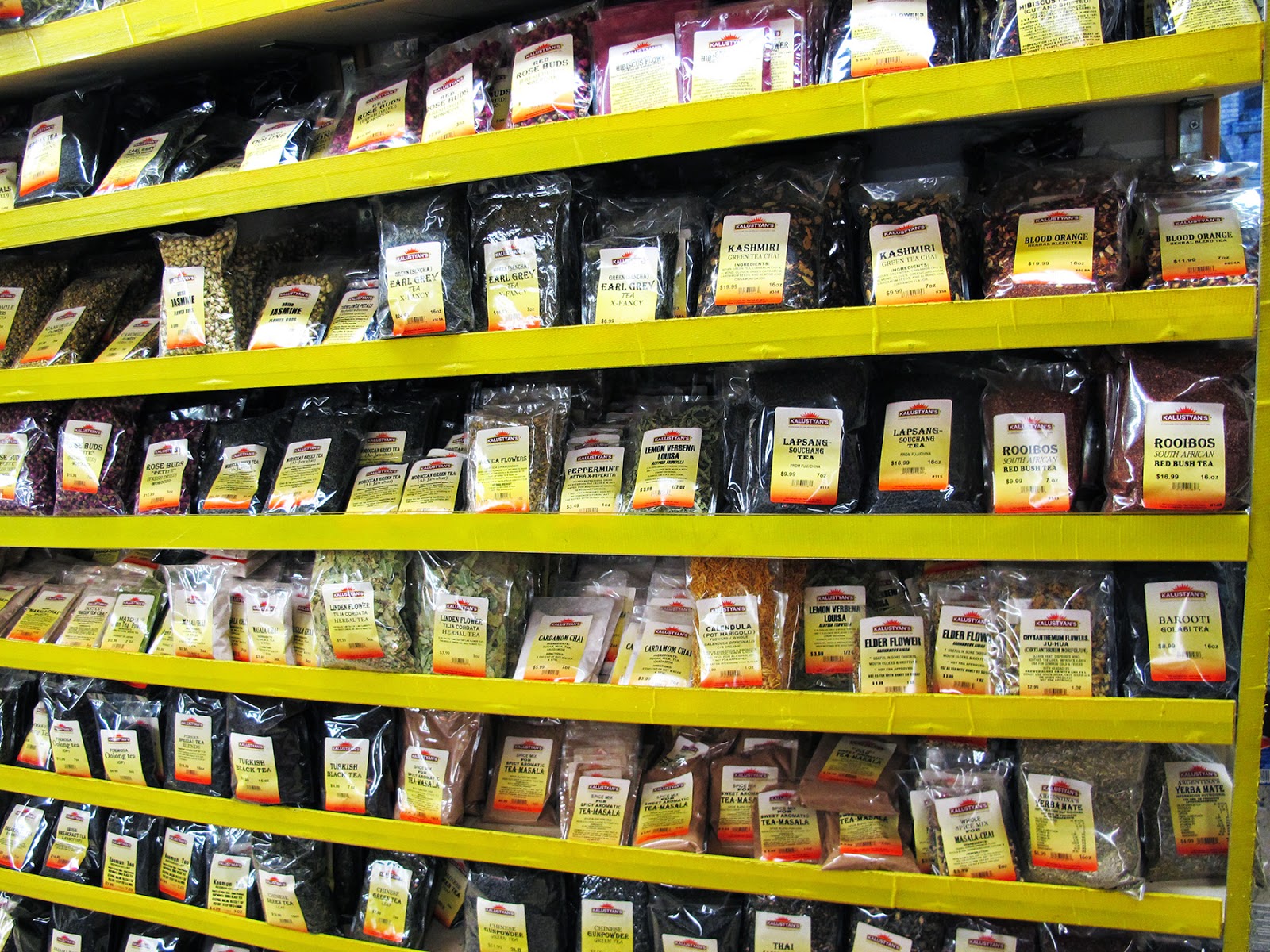
In this place you can find   ingredients  for cooking   from   Armenia, Australia, Bangladesh, Belgium, Bulgaria, China, Egypt, England, French, Germany, Greece, Guatemala, Holland, Indonesia, Iran, Israel, Italy, Japan, Jordan, Lebanon, Malaysia, Morocco, Pakistan, Philippines, Romania, Spain, South-Africa, South-America, Saudi Arabia, Sri Lanka, Syria, Thailand, Tunisia, Turkey, Vietnam, West Indies, Yugoslavia and many other countries . 

The spices are arranged alphabetically, along with subcategories. For example, there is cinnamon. But first it's cassia cinnamon from Indonesia, then cinnamon from Vietnam, and what the label says is the most forward-flavored, from China, plus others from Ceylon and India, in stick, bark or powdered form. There are sweet paprikas, smoked paprikas, hot paprikas, Hungarina paprikas....

And it is not only about spices- you can find  kosher sugar cubes from Finland and   sugar from Bali, Indonesia, tapped from palm flower spikes and kettle boiled over an open hearth. There are about forty kinds of different coffee- beans and grounded , and almost two hundred different teas.  You can buy a lot of  spices  online -  but I advice you - visit the shop - the smell  is so inviting !


The oldest apothecary in America


C.O. Bigelow Apothecary  at 414 6th Avenue  is the oldest  apothecary in America. It was founded in New York’s Greenwich Village 1838 by Dr. Galen Hunter as the Village Apothecary Shop. Clarence Otis Bigelow worked for Doctor Hunter and eventually took over the shop.
The original store was located a couple doors down from the current address, but in 1902, the ambitious Bigelow built a new building for himself  and the shop.

The  Bigelow archives told that Mark Twain 
( he lived  at 14 West 10th Street in Greenwich Village from 1900 to 1901)  bought the toothpaste there. When Thomas Edison ( as featured in advertisements ) burned his finger on a prototype light bulb, he ran into the store for balm. 

 Eleanor Roosevelt often used her friend Esther Lape's Manhattan apartment at 20 East 11th Street as her "hiding house," a comfortable private space where she could meet friends and colleagues. She often visited the store. Until the in-store soda fountain was torn down in 1984, the lunch counter cooked a whole turkey every day.


Apothecary operates on a slogan: “If you can’t find it anywhere else, try Bigelow.” 

For three generations, Bigelow has been run by the Ginsberg family. Ian Ginsberg, the 50-year-old grandson of the man who bought the store in 1939 now heads up the landmark shop.  Ian  has been working in the store since he was 6 years old.

He travels all over the world looking for unique health and beauty products, and imports many brands hard to find here in the states.
In 1980s  the chain pharmacies started coming Duane Read, CVS, etc. It was difficult time for the company.
 

"We make soaps, perfume oils, essential oils, massage oils, cosmetic bags, and many other items. And we manufacture Alchemy, our own complete line of cosmetics." – said Ian., “We´re a 100-year old pharmacy. You can create a company overnight, but you can´t create 160 years of history overnight." The store-labeled  Bigelow Lemon Body Cream has been a favorite formulation since 1870.


Ian now no longer has any fear of competition from the big chains – he has his own niche:  Bigelow´s specialized in real customer service.
 
The oldest  still-operating pharmacy in the world is  The Santa Maria Novella Pharmacy in Florence, Italy.  It was  established in 1221, when the Dominican monks from the adjacent Basilica of Santa Maria Novella began growing herbs to make balms.  In the 17th century, the pharmacy opened its doors to the public.

In 2012 Officina Profumo-Farmaceutica di Santa Maria Novella will celebrate 400 years of uninterrupted business