Showing posts with label Arts. Show all posts

What is Salmagundi?


Salmagundi refers to either a salad like dish or a pirate-style stew that came about in the 17th and 18th centuries . The stew includes   anything the cook has on hand. 
Salmagundi  as a  salad  has meat, anchovies, eggs, and onions, often arranged in rows on lettuce and served with vinegar and oil, and spiced with anything available.    The French word "salmagondis" means a hodgepodge or mix of widely disparate things. 


Salmagundi is also a name of a  the literary magazine that was found by Irvin Show in  January 1807 in New York.  Irwin Show is American playwright and novelist whose written works have sold more than 14 million copies.
 Irvin used different pseudonyms such as  William Wizard and Launcelot Langstaff and wrote a  lot of satiric articles about the life in New York .  In its seventeenth issue, dated November 11, 1807, Irvin used the word "Gotham" as a nickname  for New York for the first time. I wrote about  it in one of my earlier posts.
Salmagundi is also a name of the club, one of the oldest art organizations in the United States.
Salmagundi Club,   originally called the New York Sketch Class,  it had its beginnings in Greenwich Village where in the studio of the sculptor Jonathan Scott  Hartley a group of artists, students, and friends at the National Academy of Design gathered weekly on Saturday evenings. Hartley  sculpted three of the nine busts around the front of the Thomas Jefferson Building of the Library of Congress in Washington, DC.

The Club adopted its present name a hundred years ago after Washington Irving published "The Salmagundi Papers".   The name also serves as the club dining room's famous "Salmagundi Stew".  
The club had several temporally locations and  in 1917   purchased the 1852 Irad Hawley brownstone townhouse at 47 Fifth Avenue between East Eleventh and East Twelfth Streets. Hawley  was   the  first president of the Pennsylvania Coal Company.  The borough of Hawley in Pennsylvania in Wayne County was named after him. 

The Club offers programs including exhibitions, painting demonstrations, and art auctions throughout the year for members and the general public.


The  club has  three galleries, a library,  and a restaurant and bar with vintage pool tables. All facilities are available for special events and private rentals.
The Club owns a collection of over 1,500 works of art spanning its 140 year history and has a membership of nearly 850 artists and patrons.


The Salmagundi Club offers a variety of Art Classes, all open to the public. All classes are $20 per class to attend and are "walk-in" classes (no advance notice is required). Attendees must bring their own art supplies but easels and tables are provided as are models for the life drawing classes.

MAD museum

Columbus circle
  In the southwest corner of the Central Park, across from the Maine Monument ( look at one of my posts)   is the Columbus Circle rotary with a   Columbus Monument designed by Sicilian sculptor Gaetano Russo in the center. There is the Museum of Arts and Design (MAD) on the south side of the circle( Columbus circle,2)
MAD was founded in 1956 by Aileen Osborn Webb as the Museum of Contemporary Crafts and later became the American Craft Museum. Mad is the  only New York museum with an Open Studio program that enables visitors to observe and interact with artists engaged at work within programming spaces.
Columbus 2 , April 2014


From  1986 until 2008 MAD was located at 40 West 53rd Street and in September 2008 opened its doors at Columbus circle.

Columbus 2 before 2008 renovation


 The seven-story Pabst Grand Circle Hotel, a combination theater, hotel and restaurant, designed by William H. Cauvet, stood at this address from 1874. In 1960 the hotel was demolished to free the space for the  New York Coliseum.  From 1964 to 2005 the site contained a 12 story modernist structure designed by Edward Durell Stone for Huntington Hartford, heir to the founder of A&P Supermarkets, to display his art collection.   Stone was the principal designer on the Radio City Music Hall and  Museum of Modern Art in New York.  The building at Two Columbus Circle  opened  as the Gallery of Modern Art.


In 1969   the Gallery of Modern Art  was closed , and the building used as an  art exhibitions center for Fairleigh Dickinson University.
In 1996 the building  turned thirty years old and became eligible for landmark designation. The New York City Landmarks Commission never held a public hearing on its fate and despite a serious preservation effort, the Museum of Arts & Design has radically altered the building for their occupation in 2008.
Architecture critic Nicolai Ouroussoff named the new building as one of seven structures in New York City that should be torn down because they "have a traumatic effect on the city."
Nicolai wrote: “... As a result, the facade is being utterly revamped. ... This was an atrocious betrayal of the public trust. ... A similar debate is unfolding in Berlin, where the German government plans to demolish the 1970s Palast der Republik. ... Both 2 Columbus Circle and the Berlin building represent important moments in their cities' collective memories.”
The redesigned building has the same massing and geometric shape as the original,  but the original white Vermont Marble has been replaced with a glazed terra-cotta and glass façade.

Museum has  four floors of exhibition galleries,  150-seat auditorium and a restaurant.  It also includes a Center for the Study of Jewelry,   Education Center   and three artists-in-residence studios. MAD is the only American museum with a gallery dedicated to contemporary and modern studio and art jewelry. Museum is open late on Thursday  and Friday when you can pay what you wish.

In July 2014, the Museum of Arts and Design will inaugurate NYC Makers: The MAD Biennial, an exhibition that spotlights the creative communities across the five boroughs today.

Various spaces in the Museum are available for private events, including our 7th floor, atrium, and our 143-seat theater.
There is a  modern American restaurant Robert   on the top floor of the museum building with an amazing view of Columbus Circle and Central Park. There is a live jazz music almost every night. Open Table has about five hundred  reviews with the  more than five stars- excellent result!

The Secret Garden in the Museum of Modern Art

It is difficult to find a peaceful and quiet place  in the middle of Manhattan.  

The Sculpture Garden in the Museum of Modern Art is one of such places. 
The secret garden is hidden behind a tall wall in the heart of Midtown, on West 54 between 5th and 6th avenues.   
Beginning September 9  2013, the garden is free for visiting every morning  from 9AM to 10-15AM. The entrance is from West 54th.  


 Museum of Modern Art (MoMA) was organized in 1929 and did not have a permanent home for the first ten years.  Museum expanded in the 1950s and  the garden was added in 1953. The architect Philip Johnson and landscape architect James Fanning  designed a garden dedicated to  Abby Aldrich Rockefeller, the wife of John D. Rockefeller, Jr.  


Abby married John in 1901 and the couple had been  living at  13 West 54th Street from 1901 until 1913. In 1913 they moved to a nine-story mansion at 10 West 54th Street, the largest in New York city at the time.   Twenty-five years after  the mansion   was constructed it was demolished   to make way for the sculpture garden . Rockefellers moved   in  1938  to  40-room triplex apartment at 740 Park Avenue.


In the garden you can take a sit in a moveable chair among works by Rodin, Picasso, Calder, and other masters.   Sunken court is divided into four unequal areas with a central island and  two long pools.  I was in the garden on a chilly but bright April morning  and there was nobody except me.   The Garden Bar where you can buy  gelato or iced coffee was closed.  
I think that in summer on a weekend the garden  could be really crowded. 
Since 1971, Summergarden  on Sunday has been bringing contemporary classical and jazz music to MoMA. Admission is free but  the seating is limited if the Sculpture Garden is full.  The garden   will open at 7 p.m. on Sunday and concerts will begin at 8 p.m. and last 60-90 minutes.


Charging bull


December 1989 was one of the coldest months on record. It was very cold  dark on the early morning of December 15  1989  when the sculpture Arturo Di Modica and his friends  installed the huge 7,100 lb (  3,200-kilogram)   bronze sculpture in front of New York Stock Exchange. The night before  Arturo  visited the location and  check the   police patrol time intervals.   He had a little bit more than 4 minutes to drop the statue.

 When the artist and his crew arrive next morning they saw a Christmas tree installed on the place they chose for the bull.  So  they decided to place the statue on the yellow center line of Broad Street, outside the exchange, facing Wall Street right under the tree, as a  Christmas present. 

The New York Times wrote :
"Daylight brought crowds, and hundreds stopped to admire and analyze the bull, which was charging under the branches of a 60-foot Christmas tree, also set in the middle of Broad Street. Mr. Di Modica handed out copies of ''The Bull,'' a paean-in-a-flier to his work. ...Security officials at the exchange were calling the police. ''In effect, they told us there was a very large statue of a bull there, and it wasn't there yesterday, and to the best of their knowledge shouldn't be there,'' said Officer Joseph Gallagher, a police spokesman."


The pamphlet  attached  to  the bull, started, "The Stock Market crash of 1987 was for many Americans an event frightening ..."  The artist    saw the bull , symbol of virility and courage,  as the perfect antidote to the Wall Street crash of 1986.   Bull markets are characterized by optimism, investor confidence and expectations that strong results will continue.


Bull and bear near Frankfurt bursa
According to Investopedia, "The terms "bear" and "bull" are thought to derive from the way in which each animal attacks its opponents. That is, a bull will thrust its horns up into the air, while a bear will swipe down. These actions were then related metaphorically to the movement of a market: if the trend was up, it was considered a bull market; if the trend was down, it was a bear market."

The statue was installed without permit. While the police were deciding what to do with the bull,   the exchange hired a trucking 
company to move the bull away. 
It was a bad day for Stock Exchange-  the price of the removal was $5000 and the Dow Jones index was down 14 points.
The bull was saved by the senior office of NYC parks department who called  Bowling Green association and suggested them to put the bull on the Bowling Green.
Arturo Di Modica was born in Sicilia, Italy in 1941 and move to Florence  in  1960 where he  opened his first studio. In 1973 the artist moved to New York and  rent a  studio in SoHo on Grand Street. Later he built   his own studio  on Crosby Street where he had been working for   the  world-famous Charging Bull for over two years. The "Charging Bull"  was the third - and at last successful -  attempt of the artist  install his own statues on New York streets without permit.  In 1977  he dropped several marble statues in front of Rockefeller Center . The second time, in February 1986, he put  a big bronze horse in front of Lincoln Center. "It was a Valentine's gift to all the people in New York who are in love," he said.  
In 1999 Arturo DiModica was selected for one of the most prestigious annual awards given in the United States the Ellis Island Medal of Honor.
On the 15-year anniversary of its arrival on Wall Street, the "Charging Bull"  Arturo DiModica put the statue for sell.  The work cost US$360,000 of the artist's own money. The buyer must donate the bull to New York City with the condition that it remains at its location in Bowling Green park. The new owner's name will be placed on a permanent fixture created by Di Modica that will sit next to the sculpture. 
In May 2010 Di Modica installed similar version of the Charging Bull in Shanghai. 
Bund Bull in Shanghai

WIKI said: "It is located in the Bund, which is considered to be a location that symbolizes the era of European colonial capitalism in China   The bull is located in a square with four stock price screens across the river from the city's financial district.  The newly opened square is being called Bund Financial Square. Like its Wall Street counterpart, the Bund Bull's male genitalia is rumored to produce good luck when stroked."

Di Modica created the smaller, silver version of the bull  that sits outside his friend Giuseppi Cipriani's Abu Dhabi restaurant, Cipriani Yas Island.
The artist spent several  days in the Emirates in March 2012, negotiating for possible locations in Abu Dhabi or Dubai for the bigger version.

"If I could site a bull in the Emirates, the triangle for peace in the world will be complete," Di Modica. "I tell people; the bull is not fighting - it represents a stronger economy and consequently a better world for young people in the future."

The Cipriani’s are collectors of Arturo’s artwork, and even gotten the artist to design two of their restaurants:   Cipriani Dolci at Grand Central Terminal and Cipriani Downtown, both in New York.
The bull in Amsterdam


In July 2012 the artist placed a bronze statue of a bull,   similar to his work in New York , in front of NYSE Euronext (NYX)’ s Amsterdam bourse overnight as an antidote to Europe’s debt crisis.
“Europe is in an economic crisis. Think positive! Together we will go up!” read leaflets handed out at the square in front of the bourse by a spokesman for Di Modica.

Last year  in November Di Modica  signed an agreement with Fernando Luis Alvarez Gallery in Stamford, Connecticut. Despite living in New York since 1971, Di Modica had never had gallery representation in the United States before. You can see now a  stainless steel 8-foot-by-4-foot replica of "Charging Bull"   alongside a stainless steel horse by di Modica on Bedford Street in Stamford.

"It's been there for almost 25 years and now it is the mascot of the world," di Modica said about the Charging Bull. "It was not legal but I'm not killing anybody or robbing a bank. I'm giving my love to the people. I give them more happiness."

There is a web camera installed near Charging bull- so you can see alwais see what is going on.


Out of Hand: Materializing the Postdigital.

3D printing  is a process of making a three-dimensional solid object of virtually any shape from a digital model.  Charles Hull, later the co-founder of 3D Systems, invented  stereo lithography, a  printing process that enables a real 3D object to be created from digital data.   3D printing works by depositing layers of a material -- usually a form of plastic -- to build up a shape. 


The first working 3D printer was created in 1984.  In 2011 the first car with a 3D printed body was built.  In the same year gold and silver were used in 3D printer for the first time. Two year later the first 3D printed gun, called the “Liberator,” was  created. The company was forced to take down the blueprint for the gun from its website by the Department of State.

3D printers in the early days was very expensive. As we moved into the 21st century, costs drastically dropped. The 3D printer with the price $10,000 in 2010 now could have a price tag less than $1000! Starting form the last year Staple started selling 3d printers. Welcome, new world!
"Out of Hand: Materializing the Postdigital"  is the exhibition at the Museum of Arts and Design (MAD)on Columbus circle, Manhattan , exploring the impact of   3D printing and other   computer-assisted methods on contemporary art,  architecture, and design. 


"The digital revolution that opened the computer age is over. The amazing digital achievements of the last few decades are now taken for granted – reflecting a critical shift in thinking that has ushered in the postdigital era. In the world of art and design, discourse is no longer preoccupied with the technology in and of itself. Rather, interest lies in how technology may be creatively applied in the interplay between digital and analog, natural and man-made, biological and cultural, virtual and real. " is written on the wall in  the museum.


The exhibition features more than 120 examples of sculpture, jewelry, fashion and furniture  by eighty-five artists, architects, and designers from twenty countries.  There are  three floors of fantastic digitally fabricated creations, defined by curator Ron Labaco as anything using "computer-assisted production".  


The exhibition  demonstrate different uses for computer-assisted production methods.
 Visitors can  try out technologies including computer-aided modeling software and 3D printers, while designers-in-residence will be on hand to demonstrate some of the processes.  You can be 3D scanned   and 3D printed into mini statues  by an in-house high resolution 3D printer.

The exhibition has something for everybody, from architects and designers  programmers and other technology nerds.  You  really don’t need to know anything about design or digital fabrication to have your mind blown at the Museum of Arts and Design.


"Out of Hand is on show till June 1, 2014. Thursday and Friday night museum works late and from 6 PM to 9 PM you can pay what you wish.


Venus de Milo. Alexandros of Antioch,Dine and Dali.

New York, 6 Avenue
New York, 6 Avenue
Jim Dine is a contemporary American visual artist who was born in 1935.  Jim Dine has had numerous gallery and museum exhibitions, including at the Philadelphia Museum of Art and at the  Museum of Modern Art.


 In the early 1960s Dine produced pop art with items from everyday life. These provided commercial as well as critical success, but left Dine unsatisfied. Since the late 1980s, the artist  has sketched and studied Greek and Roman sculpture, and the form of the Venus de Milo has become one of his favorite themes, depicted in a variety of media.
New York, 6 Avenue
Cleveland
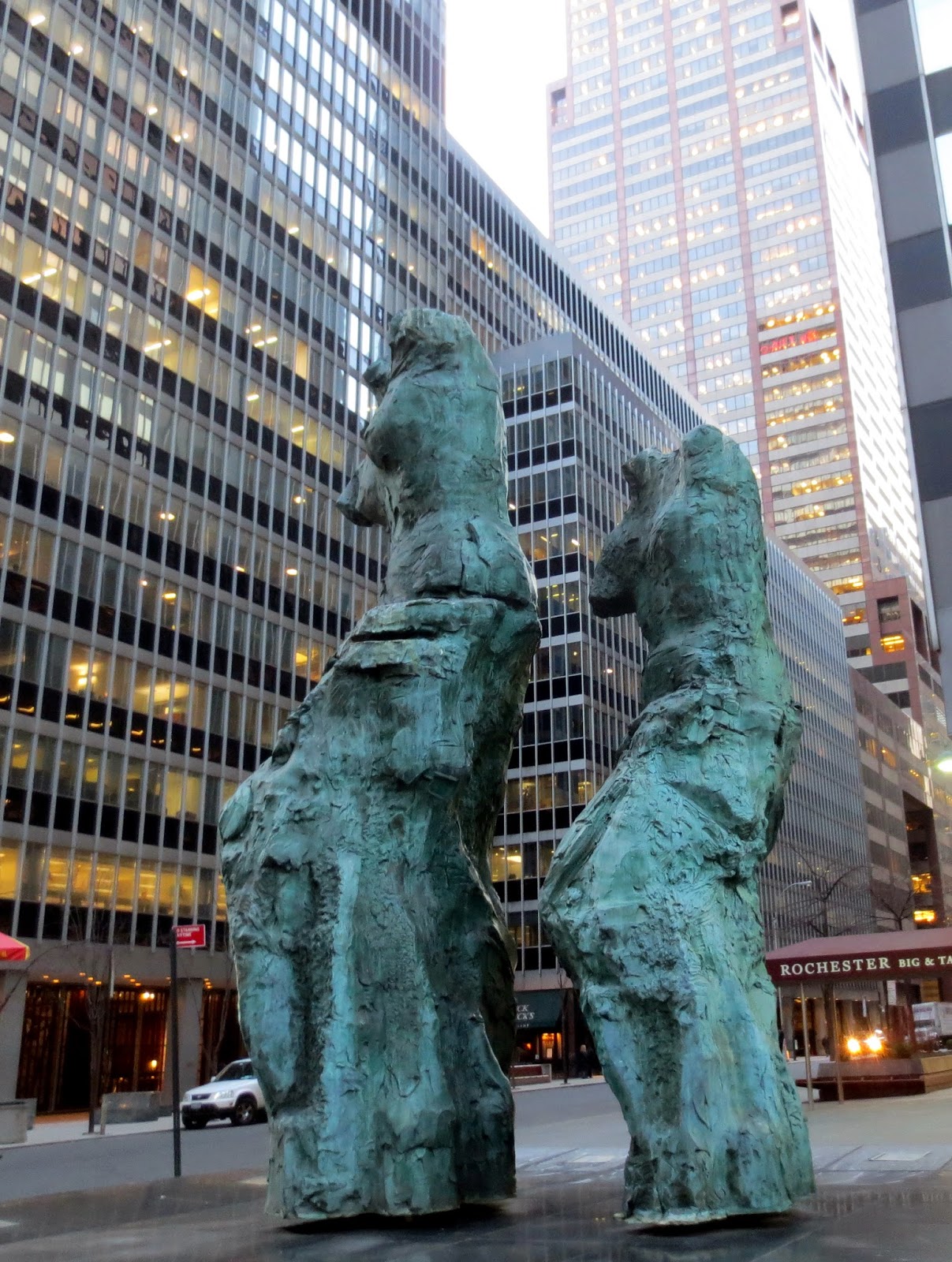
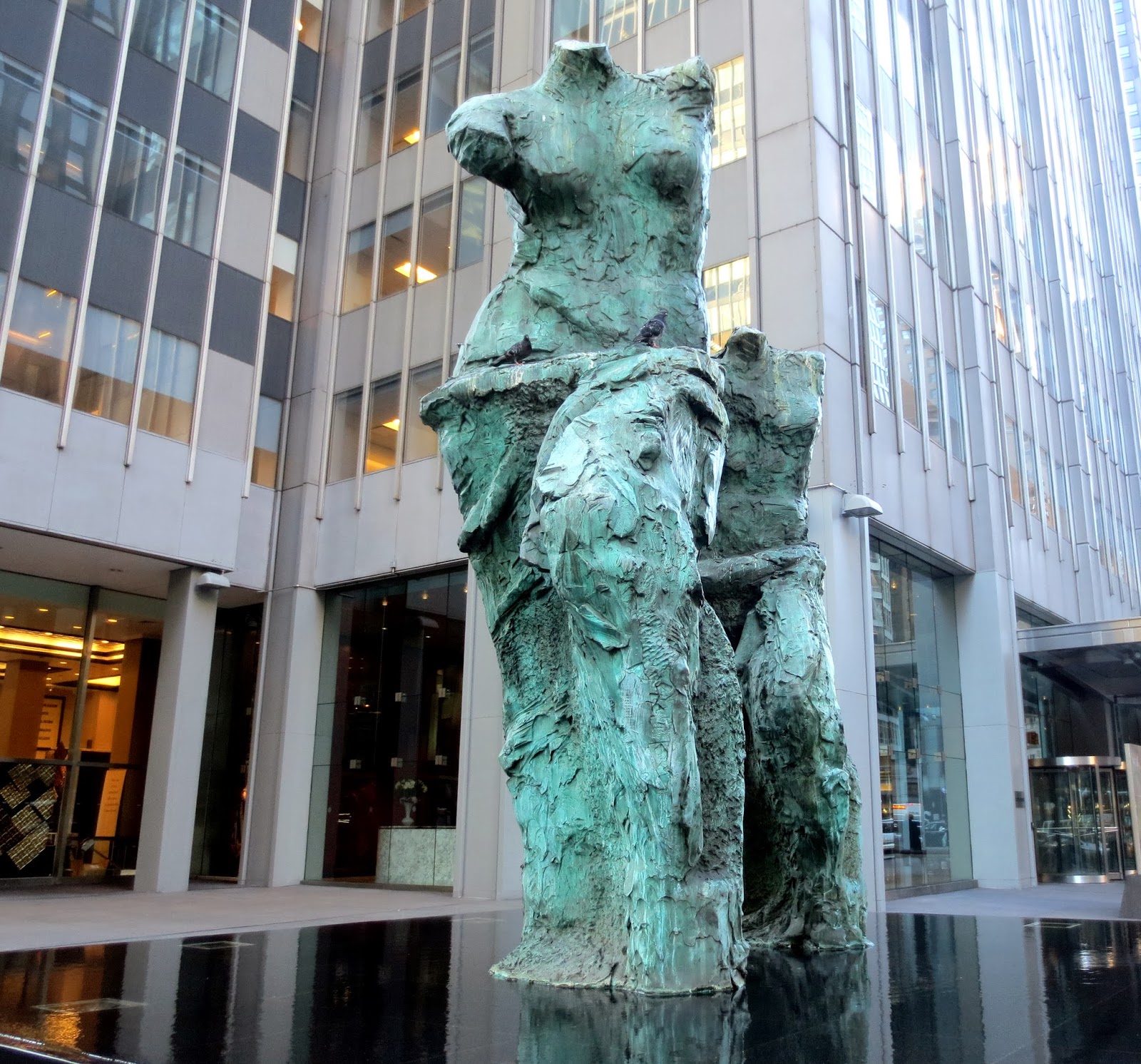
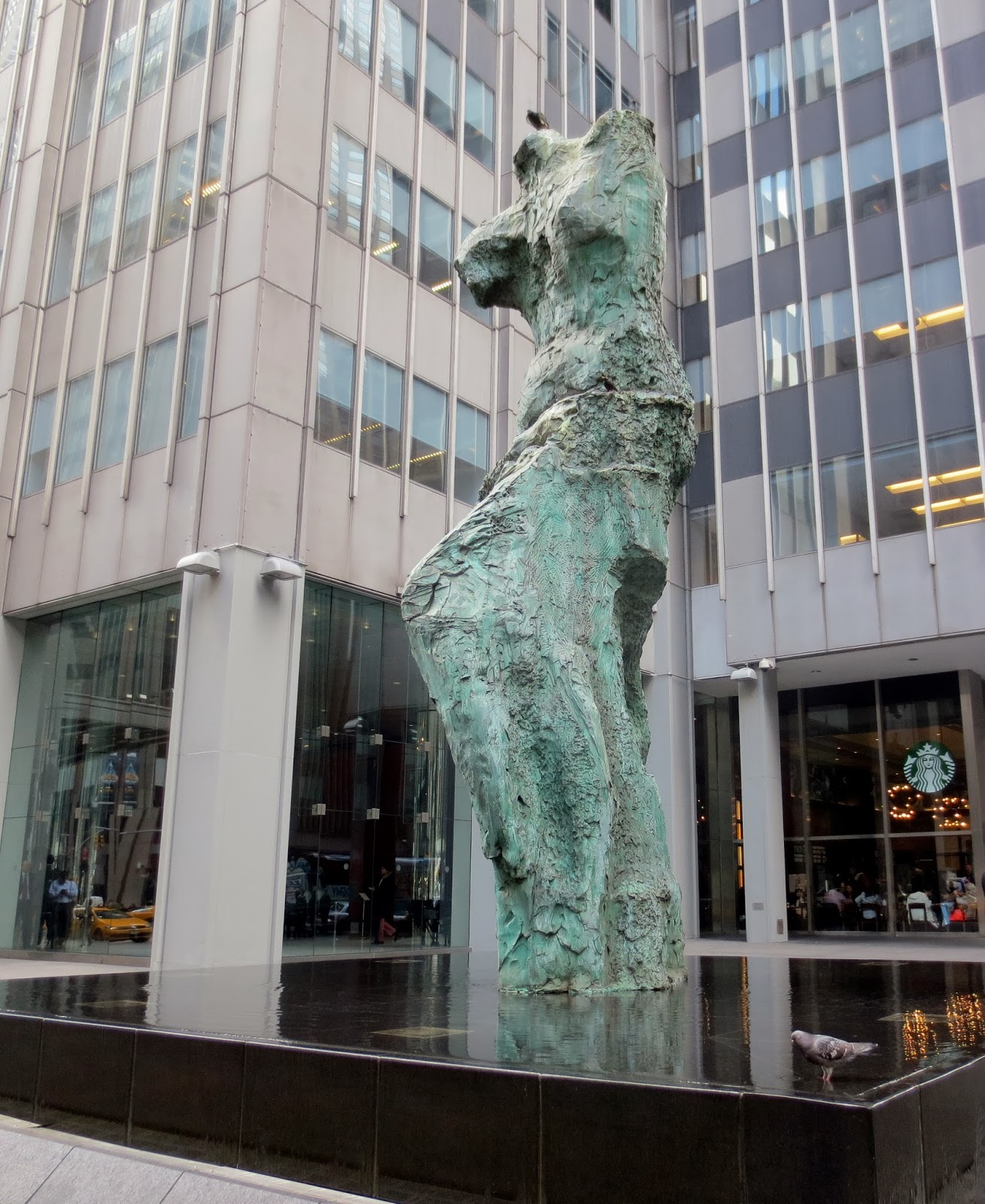
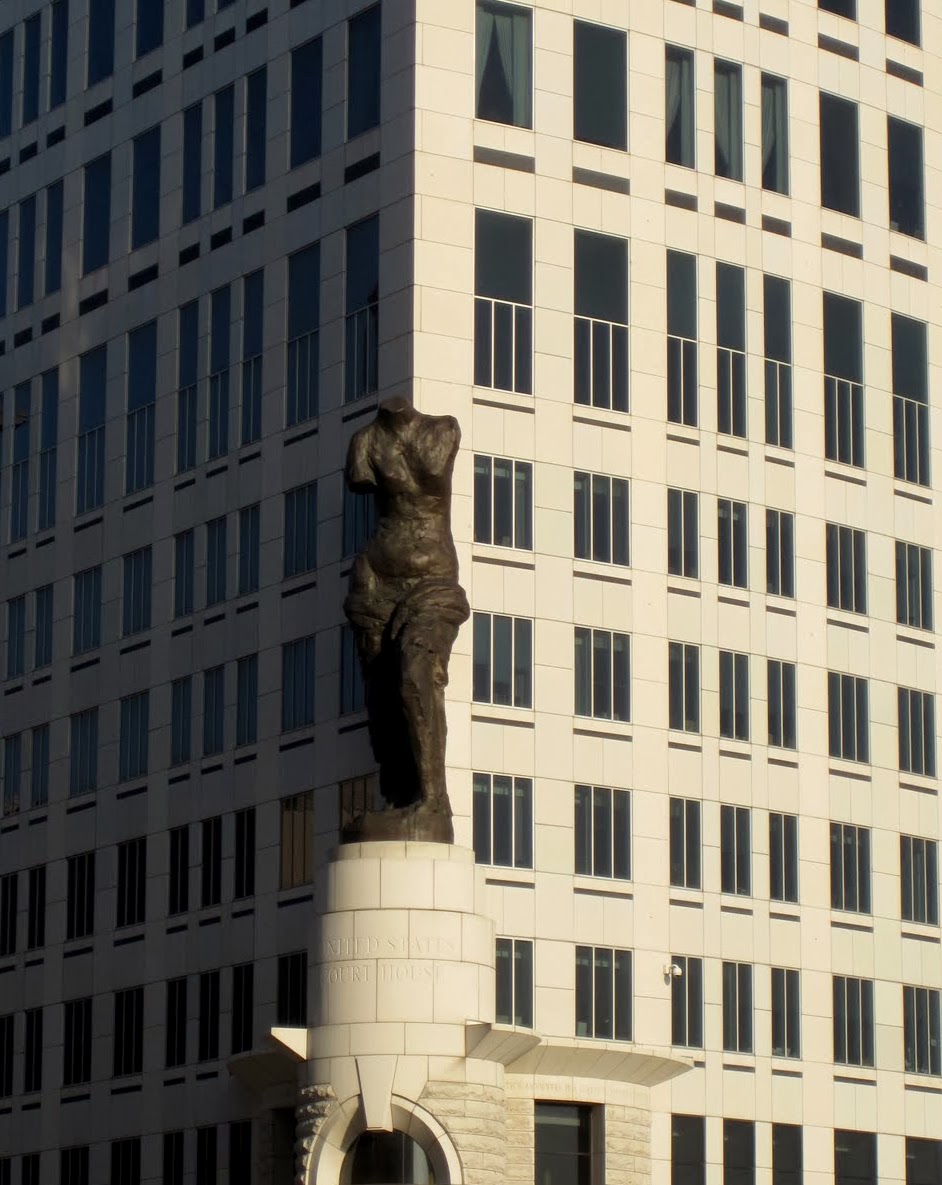
These are three of Jim Dine's sculptures collectively entitled "Looking Toward The Avenue" installed in 1989 in the small plaza on the east side of Sixth Avenue at west 53rd  and 54th Streets in Manhattan. The verdigris bronze statues  emerge from a water pool.    These sculptures  are based on Venus de Milo, a masterpiece from the 2nd century BC.  Another Venus, the largest of all of Dine's sculptures, is installed above the entrance to Cleveland's new, 22-story Carl B. Stokes Court House.
Venus de Milo. Paris, Louvre Museum
These statues were inspired by  the Venus de Milo, a masterpiece of the 2nd century BC.  The Venus de Milo was sculpted   by the artist Alexandros of Antioch as a depiction of the Greek goddess of love, Aphrodite and  is the most famous sculpture and, after the Mona Lisa, the most famous work of art in the world. It is currently on permanent display at the Louvre Museum in Paris.
The statue was discovered in 1820 on Milos island in Greece , when farmers dug up stones for their houses. Originally she was painted and adorned with accents, such as ear rings and a bracelet, intended to give her a more life like appearance. In her left hand she held an apple, the symbol of Milos, and her right arm was across her torso. The golden apple is also the symbol of her being “the fairest of the goddesses.”
The statue was found in two large pieces (the upper torso and the lower draped legs) along with several fragments. A farmer   tried to hide the statue in his stone house, but Turkish officials later seized it. The French naval officer  realized its importance and made arrangements to purchase it from Turkey. The statue was taken to France by boat and after repair work, was offered to Louis the XVIII. He presented it to the Louvre museum where it can still be seen.
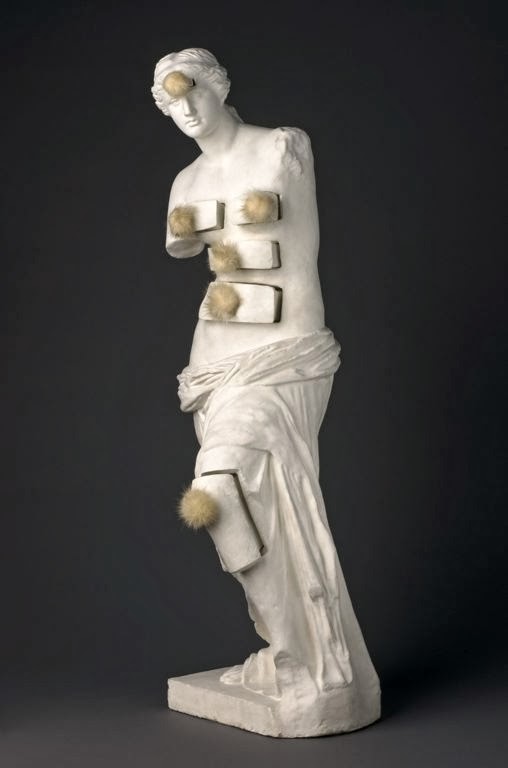
Salvador Dali, Venus with drawers
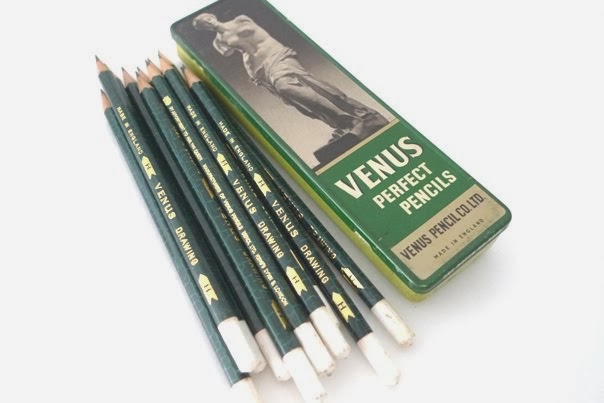
Venus de Milo  image is reproduced in advertisements, on covers of CDs, even as saltshakers. But she has also inspired artists such as Cézanne, Dali and  Magritte.   
Spanish artist  Salvador Dali   used  a statue as a model  for  ‘Venus de Milo with drawers’ .As a child, Dali's first sculpture was a clay copy of the Venus de Milo.  For 1936 Surrealist object, Dali cuts six drawers into Venus, transforming the Greek goddess into a piece of living furniture, a visual pun on the phrase "chest" of drawers, also known as a bureau. The drawers are a metaphor for the way Freudian psychoanalysis opens the hidden areas of the unconscious.   Dalí said: “The only difference between the immortal Greece and contemporary times is Sigmund Freud, who discovered that the human body, purely platonic at the Greece epoch, nowadays is full of secret drawers that only the psychoanalysis is capable to open”.

Faberge Egg Hunt, Part 1


Usually Easter egg hunt is game for small kids.  There are a lot of the egg hunts for kids all over New York this year as it  was the year before. But   this year, 2014, is special!    During the month of April, over 200 massive egg sculptures will be "hidden" throughout New York's five boroughs and all adults could have fun hunting!
 
Easter eggs   are special eggs that are often given to celebrate Easter or springtime.   The oldest tradition is to use dyed and painted chicken eggs.
The early Christians of Mesopotamia  stained eggs red in memory of the blood of Christ.  The Christian Church officially adopted the custom, regarding the eggs as a symbol of the resurrection  in 17th century.
Easter eggs are a widely popular symbol of new life in Bulgaria, Poland, Romania, Russia, Ukraine, and other Central European countries' folk traditions. A batik (wax resist) process is used to create brilliantly colored eggs, the best-known of which is the Ukrainian pysanka and the Polish pisanka.I have an excellent book with “pisanka” photos published in 1966 in Kiev.

Pysanki
 The word comes from the verb pysaty, "to write", as the designs are not painted on, but written with beeswax. Traditionally, the designs are chosen to match the character of the person to whom the pysanka is to be given. A bowl full of pysanky Easter eggs  was   kept in every home and  served not only as a colorful display, but also as protection from all dangers.
 
The most famous and expensive  Easter eggs in the world are Imperial Fabergé eggs.
Bolshaia Morskaia
Gustav Faberge  was born in province of Livonia (now Estonia) and moved to Saint Peterburg, Russia  in 1830. In 1842, Gustav Faberge founded  The House of Fabergé  and opened his own retail jewelry, "Fabergé", in a basement shop in Russia, in St. Petersburg on Bolshaia Morskaia street. 

In 1869 his son  Peter Carl sold the first pieces to the St. Petersburg Hermitage. In 1885, Tsar Alexander III commissioned the House of Fabergé to make an Easter egg as a gift for his wife, the Empress Maria Fedorovna.  The Czar gave his wife an egg every year during the Russian Orthodox Easter festival. From 1895 to 1916, his successor, Nicholas II, gave two Easter eggs each year, one to his wife and one to his mother.  A total of fifty Imperial eggs were made for the Russian Czars and 42 have survived.  The House of Fabergé was nationalised by the Bolsheviks in 1918.  
After the Revolution, the Fabergé family left Russia.  Carl Fabergé left St Petersburg in 1918  on the diplomatic train  but his two  sons were  imprisoned. Alexander managed to escape from prison when a friend bribed guards. He  and his brother Eugene opened  Fabergé et Cie in Paris in 1924. They used the trademark FABERGÉ, PARIS, whereas the Russian company's trademark was just FABERGÉ. Fabergé et Cie continued to operate in Paris until 2001.
The last two eggs two were planned for Easter in 1918, but because of the Russian Revolution the eggs were not delivered. One of these not finished eggs  is in the private Russian-owned museum outside of Russia in Baden-Baden. 

Imperial Constellation
Easter Egg
in Baden-Baden
 The founder of the museum  in Baden-Baden art collector from Moscow Alexander Ivanov has one of   the  largest Fabergé jewelry collection  in the world with more than 3,000 items.   
Faberge eggs in Saint Petersburg, Russia


Malcolm Forbes, publisher of Forbes magazine,  had the largest privately owned collection of Faberge eggs.   After he died in 2004 his heirs authorized Sothebys   to auction off his large Fabergé collection.  But before the auction took place, a private sale took place and the entire collection was bought by  the third richest person in Russia  Victor Vekselberg, the chairman of  Tyumen Oil, and taken back to Russia.  Vekselberg is the single largest owner of  Imperial  eggs in the world (11 eggs). In a 2013 BBC Four documentary, Vekselberg told he had spent just over $100 Million purchasing the 9 Fabergé eggs.  In December 2013 Vekselberg  opened a Faberge museum in the Shuvalov Palace in the  center  of  Saint Petersburg, Russia to display his  collection.
Faberge eggs in Metropolitan Museum

 
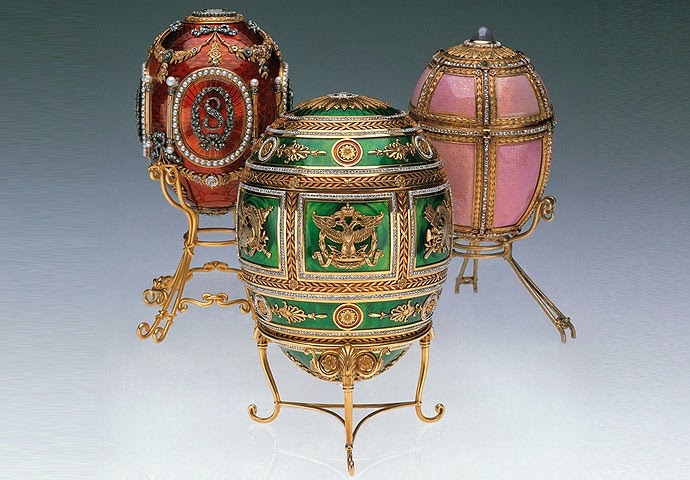
The Metropolitan Art Museum in New York is exhibiting the Fabergé collection of Matilda Geddings Gray, on long-term loan for the next five years.  Collection includes three magnificent Imperial Easter Eggs. Museum does not have its’ own Faberge egg!   
If you’d like to know about the lost egg recently  found  and  how to win one of three Fabergé prizes in New York Egg hunt- read my next post!