Showing posts with label Grand Central. Show all posts

Grand Central Terminal on holidays


"The Grand Central Terminal is not only a station," The New York Times declared in 1913, one hundred year ago, "it is a monument, a civic center, or, if one will, a city”. The station looks beautiful during the day and at night, and there's quite a lot to do inside. 
There's something about this iconic building that draws people from all over the world.  Look at my posts: "Grand Central Terminal Post 1" and  "Grand Central Terminal Post 2".

There is a  Grand Central Market - year-round indoors version of a farmer’s market.   It is open   seven days a week (Mon. - Fri from 7 am - 9 pm; Sat. from 10 am – 7 pm; Sun. 11 am – 6 pm). It is mostly  pit stop for commuters and  a place where you can  grab prepared foods on the go.  

There are three more reasons  to visit Central Terminal on the  Holiday  Season 2013:
1. In addition  to the  food market   Grand Central Terminal’s 14th annual Holiday  Fair with more than 70 vendors started several days go.  The stands in the Vanderbilt Hall  offer  a wonderful array of holiday gifts- jewelry and accessories for men and women, bath and body items, home goods, collectible toys.

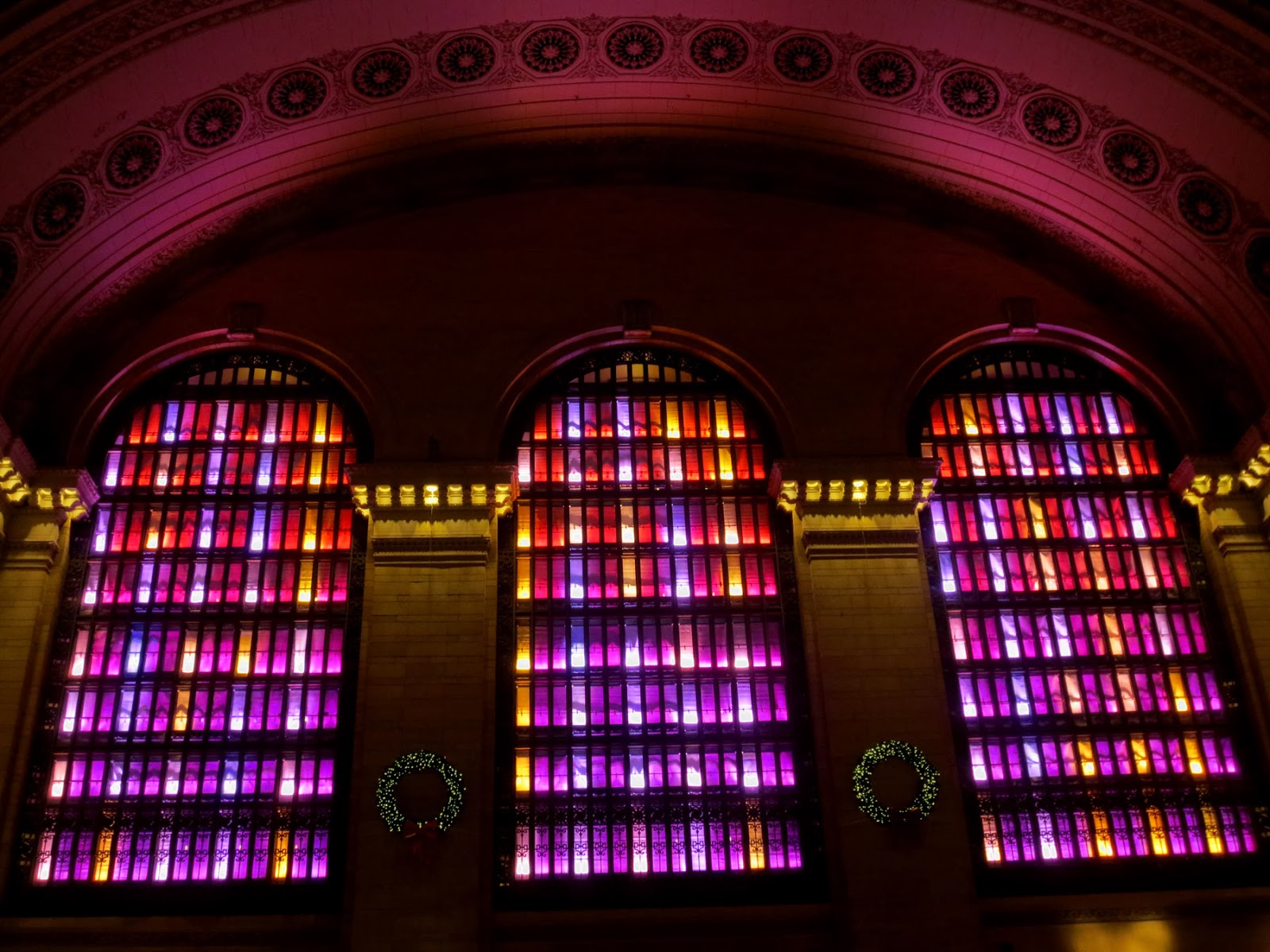
2. In partnership with MTA Metro-North Railroad and Grand Central, Toshiba has created a state-of-the-art light show that transforms the 118 separate window panes into individual "pixels" of light. A  winter holiday-themed show  will run through December 26.

3. The New York Transit Museum Gallery Annex and Store at Grand Central Terminal has its 12th  annual Holiday Train Show with the small  trains   traveling through a two-level, 34-foot-long  miniature New York City and countryside scene.

Eagles on the roof. Grand Central Terminal. Part 3

Grand  Central Terminal. Part 1
Grand  Central Terminal. Part 2
Grand Central Terminal is 100 years old this year.  Before Grand Central Terminal, there was Grand Central Depot, built by William Vanderbilt in 1898 as the expansion of the old station.  There were four clock towers on the roof, and at the corners of those towers  there were 12  huge  cast iron eagles. The eagles at that time were recognized nationally as a symbol of the country’s growth.  They represented flight, movement, travel and were a symbol of patriotism.
 The corners of the 61st floor of The Chrysler Building, built in 1928, are graced with eagles. There were eagles on the Pennsylvania Train Station, that was built in 1910 and demolished in 1963.
 Old Grand Central Depot was destroyed  in 1910 to give  way for the new station, built in 1913.  Two massive black iron eagles from the flock that rested on Grand Central Depot roof, were taken to the entrance to Willie K’s Centerport, Long Island, Eagle’s nest and today greet the visitors.
     The beautiful Spanish Revival mansion   was built in 1910 and owned by William K. Vanderbilt II, founder of the New York Central Railroad . The estate  is located on the Northern Shore an hour drive from the city. There is a museum now  with extensive collection of artifacts and natural history specimens. Vanderbilt traveled around the globe and his collection  is the largest privately held collections of marine specimens in the world. 

     Different private estates and institutions bought other eagles.   By mid-century, the majority of these estates had been divided into smaller lots, and many of the birds were almost lost.
     One of the eagles was found more than 70 years later. The couple from Bronx found it in the backyard of their newly bought  house  in Bronxville.
     The bird was almost invisible because of the overgrowth.   Their daughter went to school with the grandson of Mr. Conway , the chairman of the Metropolitan Transportation Authority, which owned Grand Central Terminal. The grown-ups got in touch and Mr. Grand Pre and Ms. Hawkes decided to donate the bird to the terminal project.  It was placed at the Lexington Avenue entrance to the Grand Central Market in 1999.
     In 2001 the Metropolitan Transportation Authority, which owns the terminal, rescued another  eagle from a Franciscan Friars monastery in Garrison, N.Y. For many years it was mounted on a bluff overlooking the Hudson River on the former estate of U.S. Rep. Hamilton Fish in Garrison, N.Y. After undergoing extensive renovation, the eagle  was installed above the terminal's southwest entrance, at 42nd Street and Vanderbilt Avenue, complementing the other original eagle perched above the entrance to Grand Central on Lexington Avenue and 43rd Street.


    Architectural Iron company  did the restoration work in both cases. Each Eagle was nine high, with a wingspan of 14 feet and a weight of 4,040 pounds.  Architectural Iron Company wanted realism and perfection in all respects and called upon the expertise of Bill Streeter of the Delaware Valley Raptor Center. Iron Company wanted to know what color to pain the eagle's tongue( eagle's tongue is pink). 

      The Bald Eagle became the National emblem in 1782 when the great seal of the United States was adopted.   The bald eagle is displayed on the backs of American monetary units, military coats of arms and national symbols all over the country.You can see the image of the bald eagle almost everywhere. 
     The head of the eagle is not bold at all -  it is  covered with white feathers. Of all birds in the world, Bald Eagles hold the record for the biggest nest ever built.

     Six years ago, in 2007, another eagle from Grand Central Depot was found by the investigators from “History Detectives” by PBS (Public Broadcasting Service in US). The eagle belongs to family-run  Space Farms Zoo and Museum in Sussex, NJ.  More than 80 years ago, in 1927,  this place had been started as mom and dad general store. Then The Great Depression hit the country. It was difficult for the customers to find even a penny and they  brought their possessions  to trade for groceries. Elizabeth, the original owner of the farm, displayed  the treasures around the shop. It was the beginning of the museum.
     The statue's previous location is not known  - it was brought to Space Farms in the mid-1960s. Experts proofed that it is a Grand Central Station bird.
PBS published a story about the Cast Iron Eagle found in Space Farms Zoo and Museum in Sussex, NJ.
 Who knows- maybe you, my readers, will find other Grand Central Eagles…

Learn More:
PBS  with the story about the eagle
Visit  Long Island Vanderbilt mansion  
Visit  Space Farm Zoo in New Jersey 


Grand Central Terminal : history and secrets. Part 2

Grand  Central Terminal. Part 1
Grand  Central Terminal. Part 3

One hundred years  and three months ago, at 12:01 AM on February 2 the first passengers boarded trains departing from the new Grand Central Terminal on the east side of Manhattan, New York.   Grand Central is the world’s largest train terminal with 45 track platforms and 63 tracks. Grand Central is the second most visited tourist destination in New York City, with over 750,000 visitors every day. There are huge windows on the south side of the building. Similar windows, but twice the size, once graced the north wall. They were blocked when the 59-story Pan Am (now MetLife) Building went up in 1963.
     The center of the terminal is the Main Concourse, and the center of it  is occupied by the informational booth with the clock on the top. Its four convex faces are actually made from high-grade opal. The little bulbous point at the top is a compass that’s aligned to true north so the four sides of the clock line up perfectly with the four compass points of the building.

The little acorn at the top of the clock is a symbol of the Vanderbilt family. Their motto was: "From the acorn grows the mighty oak." .  In 1954 the clock  was removed for the repairs for the first time   after the Terminal was opened  in 1913. There is a spiral staircase that connects the Main Concourse booth with the informational booth one floor below.

     Initially, the architects wanted skylights to fill the ceiling of the main concourse so that the actual night sky would be exposed. That option was expensive and the French artist  Paul César Helleu painted his mural instead. His portrait with his wife made by his close friend John Singer Sargent can be seen in Brooklyn  museum. Helleu was one of the most celebrated artists of the Edwardian era in both Paris and London.  

     There were 2,500 stars painted on the 125 feet high ceiling.  The constellations, with the exception of Orion, are painted backwards. The backward zodiac is a mystery. According to one of the popular legends, The Vanderbilt’s were surprised when they started getting comments and letters from commuters about the mistake. They later claimed it was painted deliberately from God’s perspective rather than having to admit to the evident error.


    The ceiling was completely covered in the 1930s and cleaned only in 1998.
If you look carefully at the northwest corner you can see a small dark square. The spot was kept as a reminder of how dirty the ceiling was before the massive cleaning that took place here in the ’90s.

   There is a small circle in the midst of the stars right above the image of Pisces. In a 1957, after the Soviet launch of Sputnik   and in the middle of a Cold war American the  Redstone rocket was placed on the floor. There was the hole in the ceiling that was made for an anchor for the cable to secure the missile that was more than 60 feet high.


     During World War II millions of servicemen passed through Grand Central on their way to and from the front.  At this time there was a secret outpost M42 - the area as large as the Main Concourse.  During WW2 troops were stationed down there with the guns trained directly at the entrance. The subbasement contained a dozen of huge power convertors that were very sensitive.  If broken or destroyed the Central Terminal could be paralyzed. The old engines have long been replaced by solid ones, but M42 is still strictly an off-limits place 


     On June 13, 1942 a team of four Germans spies landed   five miles to the North of East Hampton, Long Island   from a German submarine, U-Boat 202. The plan was to destroy key logistical locations in the northeast, including Grand Central.  The spies buried their explosives, ammunition and detonators, changed into civilian clothes and headed for the train station for New York.   The Coast Guard found the hidden uniforms and the alarm went out.  On the morning of their second day in New York, the leader of the Group used a public phone to contact the local FBI.  The group was quickly arrested.

     Among the maze of  tunnels, corridors, and tracks there is a Track 61 – the secret rail that was used by the President  Franklin D. Roosevelt. An elevator runs straight from the track to the Waldorf-Astoria Hotel.  FDR’s   armored rail car with bulletproof windows is still parked there. 

    From 1939 to 1964 CBS Television occupied a large portion of the terminal building.  In 1958, the first major videotape operations facility in the world opened in a former rehearsal room on the seventh floor. 
 Today it is occupied by a tennis court that is accessible to the public.

On the same day when the Twins we ruined  by the terror attack, but 25 years  earlier, on September 11, 1976, Croatian nationalists planted a bomb in a   locker at Grand Central Terminal and  hijacked a plane. The bomb was found and taken to Rodman's Neck Firing Range in the Bronx where police attempted to dismantle it. There was an explosion that wounded over 30 and killed one.


In 1994, the MTA signed a long term lease on the building and began massive renovations.  These renovations were mostly finished in 1998. The quarry in Tennessee that was used in the original Grand terminal project was   reopened  to provide matching stone to fix the old staircase and to build a new one.

There is a new project now that will bring Long Island Rail Road trains to the Terminal. The project is scheduled to complete in 2019.
To be continued....

Grand Central Terminal : history and secrets. Part 1


Grand  Central Terminal. Part 2
Grand  Central Terminal. Part 3  

This year New York's Grand Central Terminal turned 100. The building is not the first one built on the same space.  Grand Central Depot, built by   Cornelius Vanderbilt,   opened  in 1871. Depot  had   an ornate Second Empire-style façade, iron and glass train shed 100 feet high  and   15 tracks—one of the largest interior spaces in America at that time. There was a four-track ventilated tunnel from 56th to 96th Street and an open track bed along Park Avenue.  Steam locomotives on all this tracks generated a lot of smoke and dust.   The traffic was growing very quickly  - there were   22 tracks in 1898.

     Vanderbilt family announced plans to construct a new station after the tragic accident happened in 1902:  one commuter train crashed into another, killing 15.  The huge dirty cloud, emanating from the station area, blinded   the train’s driver.
Wilgus, the New York Central Railroad’s chief engineer since 1899, in his letter to the railroad’s president proposed to raze the existing Grand Central and replace the steam locomotives with electric trains. The terminal, he explained later, “could be transformed from a nonproductive agency of transportation to a self-contained producer of revenue — a gold mine, so to speak.”

     In 1903 the Central invited architects to submit designs for the new terminal. One firm suggested to build a baroque, a turreted confection with  Park Avenue slicing it into two separate parts; another proposed  to build  60-story skyscraper   atop the terminal.

     Reed & Stem, a St. Paul firm, won the competition. Allen H. Stem was Wilgus’s brother-in-law. Soon after that, Warren & Wetmore (Whitney Warren was William Vanderbilt’s cousin) submitted an alternative design.

     In   1903, the   board of directors, including Cornelius II Vanderbilt and William K. Vanderbilt, William Rockefeller and J. P. Morgan approved the plan.   More than hundred houses, three churches and two hospitals have to be demolished. Grand Central Depot was demolished too.The construction of   the new Terminal lasted for ten years (from 1903 - 1913). The terminal alone cost $43 million to build, the equivalent of about $1 billion today.

     The new construction was done without disrupting  the daily arrivals and departures of hundreds of trains, whose numbers had been  increasing each year. During the entire demolition and rebuilding, train service never stopped. The work was difficult.   The quantity of rock and soil that was excavated for the two levels of tracks was stupendous—3 million cubic yards. At peak periods, 10,000 workers were assigned to the site and work progressed around the clock.

     William J. Wilgus took advantage of the recent electrification technology and proposed to build a bi-level station below ground.  Air rights over the tracks and   platforms were sold for real-estate development.  In next several years apartment and office buildings were erected around Grand Central and the area was turned the most desirable commercial office district in Manhattan – Terminal City.

     The leading architect of the building, Whitney Warren, wanted to bring a lot of Parisian flair to New York City with his Beaux-Arts style. Warren brought a bunch of his French friends who worked on the project with him.
The sculpture at the peak of the building façade that faces 42nd Street was the largest in the world when it was unveiled in 1914. Mercury is at the top with Hercules to his right and Minerva goddess of wisdom, to his left

      The building of Grand Central was the largest construction project in New York’s history up to that time and was as one of the world’s first all-electric buildings.    When the station was opened in 1913 , there were more than 4000 light bulbs in chandeliers and lighting fixtures, and all of them were uncovered. There are now over then 35000 light bulbs, but they still remain bare.

     Another innovation was the extensive use of ramps, rather than stairs, throughout the station. When the Terminal was opened   there was a separate women’s waiting room with   maids at the ready, a ladies’ shoe-polishing room  and  dressing room, and a private barber shop for men.

     Terminal had served as an important cultural hub for the city of New York. There was a movie theater, on-site museum, restaurants and even an art school, established in the 1920s by a group of painters included John Singer Sargent, which offered lessons to hundreds of students before closing in 1944.The school was on the 7-th floor of the east wing and  Norman Rockwell was one of the students.

     After fifty years of usage Grand Central  became dirty and seedy. It was dark and dusty, windows were broken. The terminal was owned by the Penn Central Railroad.  Penn was close to the bankruptcy.  The developments rights of the Penn station were sold to the company that destroyed the station.


     The beautiful Penn station was made of pink granite with   the   Greek Doric columns and had the largest indoor space in the world.  Penn Station was demolished in 1962 – there is a Madison Square garden on its place now.Penn Central Railroad proposed to do to Grand Central what it had done to Penn Station.

   The 1963 demolition of Pennsylvania Station served as catalyst for an architectural preservation movement within the United States.  New Landmarks Preservation Commission was created and  Grand Central Terminal was designated as a New York City Landmark.  The owners sued in state supreme court, claiming the new landmark law was unconstitutional. The railroad won. But New York City won the appeal and the case then moved to the U.S. Supreme Court. New York won and Grand Central was saved. This was the first time when the court ruled on historic preservation.

The building has a lot of hidden secrets such as secret room, secret track, a hole in the ceiling that intentionally was not repaired. I’ll tell about it in my next post.