Showing posts with label Brooklyn. Show all posts

June Means Roses

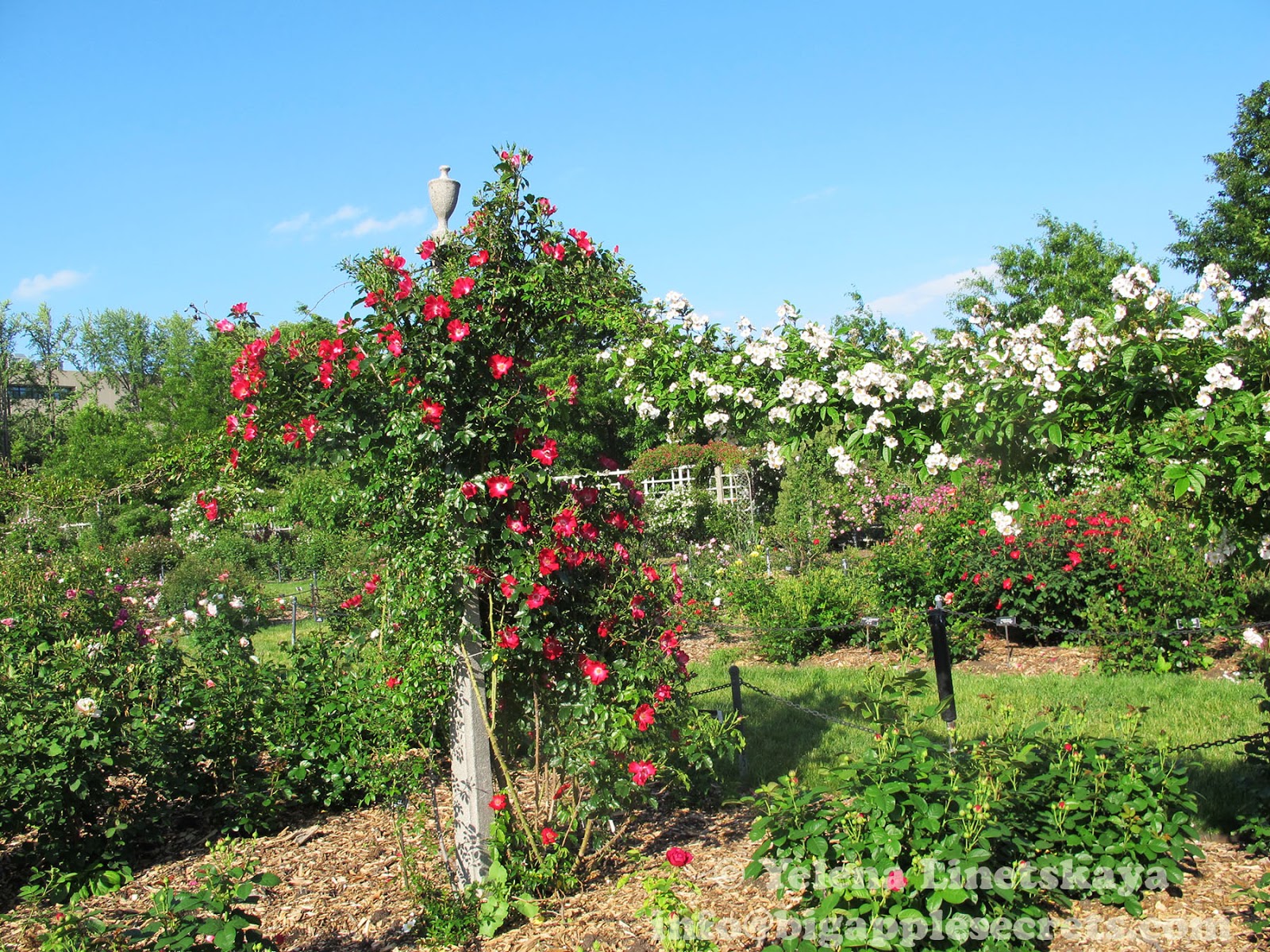
Brooklyn Botanic Garden is just several strops from Manhattan.  It is the best place to see the flowering magnolia trees in the beginning of the spring.  The garden was founded in 1910. Every year there are  about a million visitors from all over the world. In my previous posts  I told   about the garden and about its' bonsai collection.  But June is a rose month!   Collection of roses in Brooklyn Botanic garden is one of the largest in the country  and in June roses are in full bloom.

The rose (Latin, rosa, in Greek, rhodon) is a sacred symbol of regeneration, purity, virginity, fertility, sexuality, secrets, and most of all, love.

Robert Burns , English poet of the 18th century, wrote:
O my Love is like a red, red rose
   That’s newly sprung in June;
O my Love is like the melody
   That’s sweetly played in tune


It is believed that roses were grown in all the early civilizations   at least 5000 years agoRose fragments have often been found inside burial tombs.
In Greek mythology, the rose with five petals became the five-pointed star (pentagram or pentacle) of the Goddess of Love, Aphrodite and the red petals of the rose are the blood of Lord Adonis. The ancient Roman festival called “Rosalia” was part of the cult of the dead from the first century. In Alchemy red and white roses enter into the general red/white duality symbolizing the primer elements sulphur and mercury.
 
White Rose and Red Rose become first in the European history political symbol of fight for power. The War of Roses ended in 1485 with arise of new power - house of Tudor when Henry Tudor won the throne of England and united the red rose of Lancaster with the white rose of York.
 
On November 20, 1986, President Ronald Reagan, signed Proclamation 5574 declaring the Rose to be The National Floral Emblem of the United States of America. Each of the 50 states has also adopted an official state flower, including the rose in New York, the Oklahoma rose in Oklahoma, the Cherokee rose in Georgia, and the wild prairie rose in Iowa and North Dakota.
Ornamental roses have been cultivated for millennia, with the earliest known cultivation known to date from at least 500 BC in Mediterranean countries, Persia, and China.   The predecessor of the modern rose garden   was planted by the French empress Joséphine de Beauharnais, the wife of  Napoléon Bonaparte at  Château de Malmaison in the years between  .  At her death in 1814, the garden included more than 250 varieties of roses.
 
In 1927, Walter V. Cranford, a construction engineer whose firm built many of Brooklyn's subway tunnels, donated $15,000 to BBG for a rose garden. Excavation revealed an old cobblestone road two feet below the surface and tons of glacial rock, which had to be carted away on horse-drawn barges.

There are over 5,000 bushes of nearly 1,400 kinds of roses, including wild species, old garden roses  and  hybrid tea roses.  And right now the roses, of every shade from white to  pink to that perfect deep red are flowering in all their glory  - so now is the time to visit, before, as they say, the bloom is off the rose….
 

Brooklyn Bridge. 132 years. Part 2

The first part of the story is here
Brooklyn Bridge is the first bridge ever built between Brooklyn and Manhattan. At the time it was finished in May 1883, it was famous for being the biggest bridge in the world - stretching almost 1600 feet across the East River.
But it was not always the name of this  bridge.     Residents originally referred to it as the New York bridge or  even the East River Bridge. In 1867, a letter to the editor of a local newspaper called it the Brooklyn Bridge and the name stuck. Eventually, in 1915, the city government made the name official and in 1964, it was designated a National Historic Landmark.


The bridge’s construction took 14 years, involved 600 workers and cost $15 million (more than $320 million in today’s dollars). The two stone 276-feet-tall towers were the tallest structures in New York, except for Trinity Church’s spire.
On May 24, 1883, the Brooklyn Bridge was opened to the public.   Schools and businesses were closed for the whole day in Brooklyn, while Manhattan had a half-holiday . Thousands watched and cheered the ceremony and procession. For New York, the opening of the Brooklyn Bridge had much deeper significance than transportation. It bonded the cities of Manhattan and Brooklyn together.


During the first week the bridge opened, masses of people used the bridge.  On Thursday, May 31 the bridge was very crowded.  According to various accounts, someone shouted that the bridge was collapsing, and caused the panic. Another story went that there were pickpockets in the crowds and a woman screamed and fell. The loud noise frightened everyone into believing the bridge was falling.


The commotion sparked a chain reaction of confusion, as more and more people panicked and mobbed the narrow staircase, creating a massive pileup. By the time it was all cleared up, twelve people had been trampled to death.  Though the earliest news reports claimed only 35 suffered injuries, it was most likely over a hundred.


A year later, On May 17, 1884, to put down doubts of the bridge’s stability , circus maestro Phineas T. Barnum paraded his  20 elephants across the structure to demonstrate to the public that it was safe. At the head of the parade was Jumbo, the most  famous elephant in the history.
In the early 1880s, with the focus on his traveling circus, Barnum purchased a huge African elephant named Jumbo from the London Zoo. The elephant was a beloved creature in England, and its fame preceded it to America.   Jumbo got his name from his keepers at the London Zoo.  Thanks to Barnum's promotion, the word "jumbo" entered the English language and today we have everything from "jumbo drinks" to "jumbo jets." In  1885 Jumbo was hit by the train and died. The skeletal remains are in the collection of N.Y. American Museum of Natural History.


The  bridge-trains started running in September 1884. The trip across on the bridge-train took five minutes and cost 5 cents. The trains were two 300 horsepower steam engines. By 1885 the bridge-trains had carried over 20 million passengers. In 1944 the elevated trains stopped running and the old iron terminals were pulled down.

The initial charge to make the Brooklyn Bridge crossing was one penny to cross by foot, 5 cents for a horse and rider to cross and 10 cents for a horse and wagon. The price charged for farm animals were 5 cents per cow and 2 cents per hog or sheep.


 Brooklyn Bridge has inspired a remarkable number of   poems. The Russian Futurist Vladimir Mayakovsky was moved when he first saw it in 1925, as he described in his poem "Brooklyn Bridge:"
...it stretches on cables of string
 t
o the feet of the stars.
I stare
 as an eskimo gapes at a train,
 I seize on it
 as a tick fastens to an ear.
 Brooklyn Bridge--
 yes....
 That's quite a thing!

In 1956, the beat poet Jack Kerouac celebrated the bridge in another visionary poem  called "The Brooklyn Bridge Blues":

I looked at the red winter
 disgusting dusk of the world,
 saw the alleys beyond,
 Brooklyn, Wolfe's redbrick jungle


 Frank Sinatra sang:
Like the folks you meet on
 Like to plant my feet on the Brooklyn bridge
 What a lovely view from
 Heaven looks at you from the Brooklyn bridge.


There are several hidden vaults inside the bridge. Below the ramps that lead up to the anchorages on both sides of the Brooklyn Bridge are vaults, once rented out as wine and champagne storage.  The alcohol was kept in stable temperatures throughout the year and the rent helped offset the cost of the bridge. The New York Times reported that city records show that the “‘Luyties Brothers’ paid $5,000 for wine storage in a vault on the Manhattan side. ‘A. Smith & Company’ paid $500 a year from 1901 until 1909 for a vault on the Brooklyn side.”  Unfortunately, these vaults no longer store wines, but rather house maintenance materials.

In 2006 city workers were conducting a regular structural inspection of the bridge when they came across the cold-war-era hoard of water drums, medical supplies, paper blankets, drugs and calorie-packed crackers — an estimated 352,000 of them, sealed in dozens of watertight metal canisters and, it seems, still edible.  Boxes with blanket were labeled “For Use Only After Enemy Attack.”
Several historians said  that the find was exceptional, in part because many of the cardboard boxes of supplies were ink-stamped with two especially significant years in cold-war history: 1957, when the Soviets launched the Sputnik satellite, and 1962, when the Cuban missile crisis seemed to bring the world to the precipice of nuclear destruction.  The shelter was located in one of the masonry foundations of the bridge on the Manhattan side.


Brooklyn Bridge charged horse-drawn carriages a toll from the time it opened. But by the Depression, the tolls were a thing of the past. There is no toll in either direction on the Brooklyn Bridge now.


Perhaps because of the bridge's size the Brooklyn Bridge has become well known for the amount of people that jumped off of it, either for publicity-seeking fame or to take their own lives. Today, the Brooklyn Bridge has more suicides than any of the other bridges in the city, including the George Washington and Verrazano-Narrows, which are actually much higher from the water.


It would be almost two years after the bridge's opening that the first jump would be made. Swimming instructor  Robert E. Odlum  made a public announcement that he would jump on May 19, 1885, two years after the bridge was opened. Odlum, dress in a bright red swimsuit,   leapt from the bridge with one arm at his side and the other pointing in the air. He died a half-hour later from his injuries. Authorities do not keep track of suicide attempts (successful or not) from New York City's bridges, so the actual number is not known. 


The bridge was  the scene of a mass exodus from the city on September 11, 2001, as downtown workers fled the terrorist attacks that destroyed the World Trade Center. My twins were among them-they were second years students at Pace Univercity and had classes at that day.  The bridge was  closed off to all traffic for several weeks after the attacks, with the exception of emergency vehicles.


The Brooklyn Bridge has appeared in several films over the years. It  is destroyed by a tidal wave in Deep Impact (1998) and is shown briefly in Independence Day (1996) right before an alien ship destroys the city (and presumably the bridge).


Today more than 120,000 vehicles, 4,000 pedestrians and 3,100 bicyclists cross the Brooklyn Bridge every day.  There is a pedestrian walkway with a bike lane that rises above the traffic.  At just over a mile long, this is one of the most scenic routes to take for views of both boroughs.  The skyline seen through the rays of cable are iconic.

Brooklyn Bridge. 132 years. Part 1

It took more than a decade to build this bridge,  it cost the life of its designer, and it  was constantly criticized by skeptics who predicted the entire structure was going to collapse.  When the bridge   opened  132 years ago,  on May 24, 1883 the world took notice and the entire United States celebrated.  Do you know what bridge  I'm talking about?  Yes- you are right -  this post is about Brooklyn Bridge.

Before the Brooklyn Bridge was built, there was no way to cross the East River from Brooklyn to Manhattan, or Manhattan to Brooklyn, except by boat.   There was a ferry system, but  the ferries were  too small and too slow, and there were not enough of them. In the winter, the East River sometimes froze, making ferry travel impossible. Since the ice rarely froze solid enough to walk over, traveling over the river was virtually impossible.  Walt Whitman, an American poet, who founded  a weekly newspaper Long-Islander,  wrote his great poem "Crossing Brooklyn Ferry" before the bridge was built:

The current rushing so swiftly, and swimming with me far away;
The others that are to follow me, the ties between me and them;
The certainty of others--the life, love, sight, hearing of others.
Others will enter the gates of the ferry, and cross from shore to shore;
Others will watch the run of the flood-tide;
Others will see the shipping of Manhattan north and west,
and the  heights of Brooklyn to the south and east;
Others will see the islands large and small.

Ideas for many different types of bridges and tunnels were discussed for more than 50 years before the Brooklyn Bridge was built. There was even an idea for a bridge that would float on the water. he bridge was initially designed by German immigrant John Augustus Roebling, who had previously designed and constructed shorter suspension bridges. 
Roebling was born   in 1806  in Mülhausen, Prussia — now part of Germany.  He  received an excellent education ,  learned French  ,   studied architecture and engineering and became fascinated with suspension bridges.   John immigrated to America at age 25 with his brother Karl and other Germans. They settled in western Pennsylvania and founded a farming village they called Saxonburg  in Butler County  near Pittsburgh.    Johns ' eldest son Washington Roebling joined him in his work, and in the 1850s and 1860s they built four suspension bridges.

In 1867 Roebling started design work on what is now called the Brooklyn Bridge.  Two years after  in 1869, just three days after construction began, Roebling's foot was crushed while determining the exact location of the bridge's tower. Suffering from  infection, Roebling died 2 weeks later.    His  son Washington    with help from his wife Emily  continued  direct control over the Brooklyn Bridge's construction.  Under her husband's guidance, Emily studied calculus,   the strengths of materials, bridge specifications, and the intricacies of cable construction.

Washington made several important improvements on the bridge design.   He designed the two large pneumatic caissons that became the foundations for the two towers. Working in compressed air in these caissons under the river caused him to get decompression sickness   crushing his health.  He became paralyzed and was bound to a wheelchair as a paraplegic for the rest of his life. Unable to work anymore, Washington Roebling could do nothing but sit in his bedroom at his Brooklyn Heights apartment and watch the construction of his family’s masterpiece through a telescope.

His wife Emily   not only cared for her husband, but also became his “assistant engineer”.  She oversaw the daily running of the bridge’s construction, she relayed Washington’s orders to his on-site assistants and made sure that everything ran as smoothly as possible.
The Brooklyn Bridge was completed in 1883.   A  delegation including the mayor of New York and the President of the United States, Chester A. Arthur, walked from the New York end of the bridge to the Brooklyn tower, where they were greeted by a delegation led by Brooklyn's mayor, Seth Low.  Emily  Roebling was to be the first person to cross the bridge.    Shops closed, bells tolled and people from all over came to witness this grand event.  Massive fireworks display lit the sky at that night 132 years ago, on May 24, 1883.

To be continued...

Bonsai collection in Brooklyn Botanic Garden


Brooklyn garden has one of the largest and oldest bonsai collections on public display outside Japan.

The art of Bonsai   traces back almost 2000 yrs. The word bonsai is made up of 2 Japanese characters or word phrases, "bon" & "sai", " Bon" is the pot , tray or container, the "sai" is the tree or potted planting.  The original word Bonsai comes from the Chinese word "P'en Tsai" it sounds similar to bonsai and has nearly the same meaning.  Later on in time, the practice began to spread its reach to all of Asia and was used more in society among families of royal background. 


The art has always been considered a delicate way to express  one’s own heritage and honor. By the 17th and 18th century  the planting and growing bonsai tree was becoming more commonplace to the general Japanese public. The art of bonsai was introduced to the U.S. in the late 19th and early 20th centuries. After the Paris World Exhibition in 1900, the art of bonsai spread like wild fire to many travelers.
Brooklyn Botanic Garden   bonsai collection began in 1925 with 32 potted trees—a gift from American landscape designer Ernest F. Coe.  


  Mr. Coe imported bonsai plants from Japan in 1911. He grew the trees for several years  and later, moving to Florida, donated  his collection with 32 potted trees   to the Brooklyn Botanic Garden. Coe was the founder of the  Everglades National Park in Florida. 
The Garden's first bonsai master was Frank Okamura.  Frank Masao Okamura was born in Hiroshima in 1911   and moved to California when he was 13 to join his father. In 1942 he and his family were sent to the Relocation Camp in the California desert. The family lived there for more than three years.   After the war ended the family moved to New York.  Mr. Okamura worked  with Brooklyn Botanic Garden from 1947 until 1981. 
White Pine 62 years


 Emperor Hirohito awarded Mr. Okamura an Order of the Sacred Treasure medal in 1981 for his work in furthering knowledge of bonsai.  Mr. Okamura taught his students that practicing bonsai required patience, sensitivity to nature and five fundamental qualities: humanity, justice, courtesy, wisdom and fidelity.
 Today, the collection consists of approximately 350 temperate and tropical bonsai. Some of the trees in this world-class collection are well over a century old.


Julian Velasco , curator of Brooklyn Botanic Garden's bonsai collection, said: "There is a concept behind the shape of every bonsai that I care for. I started as a nature photographer.I’ve probably hiked and camped in every major national park in our country. And the challenge is the same as working with the bonsai: how can you capture the entire emotional experience of seeing what you see, feeling what you feel, in nature, in a single shot?  When you see the Grand Canyon or Yosemite, you are taking in the emotion of the place as much as the visual image, and bonsai is about that emotion, he said. It is the haiku of the tree world.”