Showing posts with label Park. Show all posts

June Means Roses

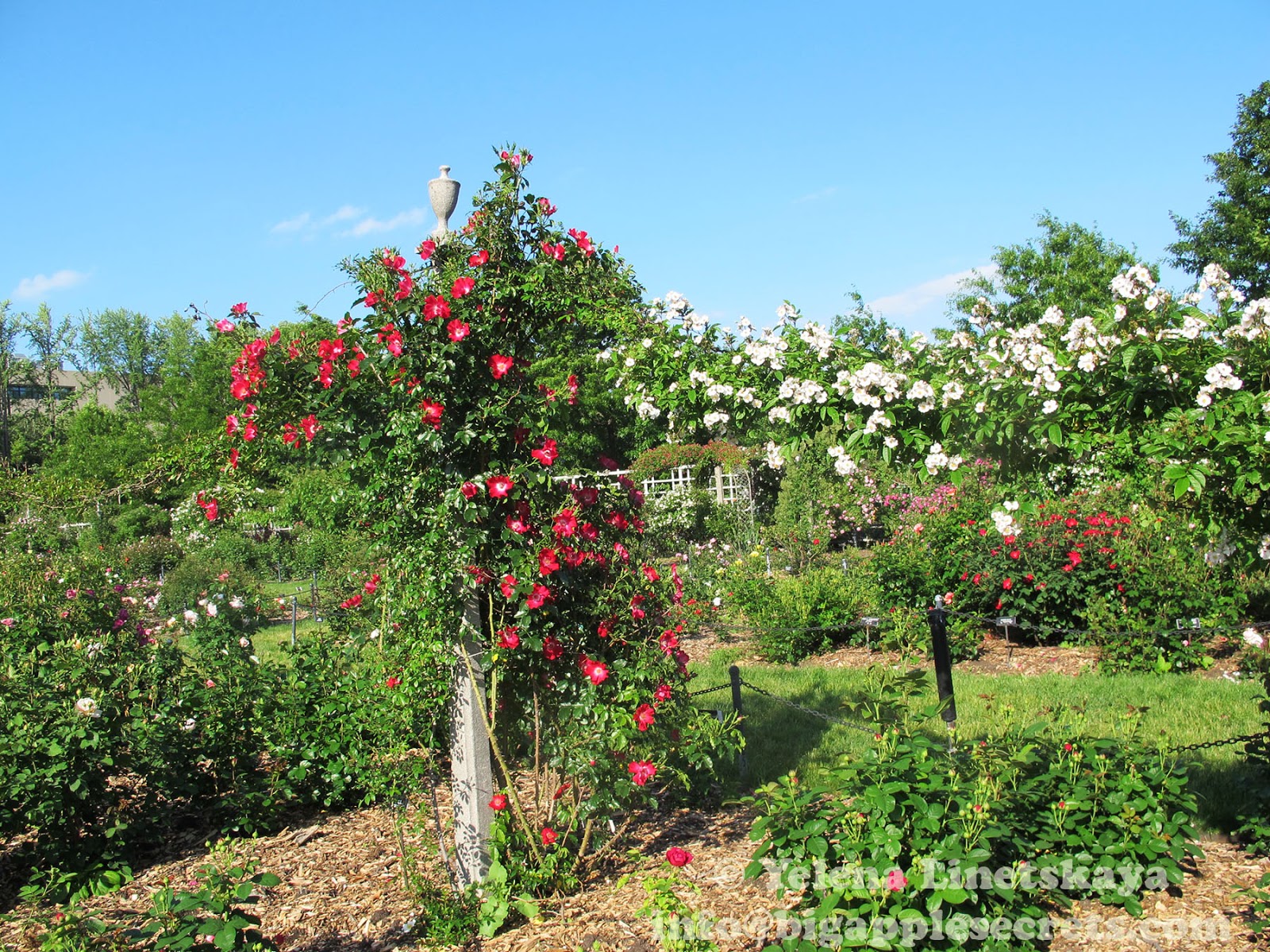
Brooklyn Botanic Garden is just several strops from Manhattan.  It is the best place to see the flowering magnolia trees in the beginning of the spring.  The garden was founded in 1910. Every year there are  about a million visitors from all over the world. In my previous posts  I told   about the garden and about its' bonsai collection.  But June is a rose month!   Collection of roses in Brooklyn Botanic garden is one of the largest in the country  and in June roses are in full bloom.

The rose (Latin, rosa, in Greek, rhodon) is a sacred symbol of regeneration, purity, virginity, fertility, sexuality, secrets, and most of all, love.

Robert Burns , English poet of the 18th century, wrote:
O my Love is like a red, red rose
   That’s newly sprung in June;
O my Love is like the melody
   That’s sweetly played in tune


It is believed that roses were grown in all the early civilizations   at least 5000 years agoRose fragments have often been found inside burial tombs.
In Greek mythology, the rose with five petals became the five-pointed star (pentagram or pentacle) of the Goddess of Love, Aphrodite and the red petals of the rose are the blood of Lord Adonis. The ancient Roman festival called “Rosalia” was part of the cult of the dead from the first century. In Alchemy red and white roses enter into the general red/white duality symbolizing the primer elements sulphur and mercury.
 
White Rose and Red Rose become first in the European history political symbol of fight for power. The War of Roses ended in 1485 with arise of new power - house of Tudor when Henry Tudor won the throne of England and united the red rose of Lancaster with the white rose of York.
 
On November 20, 1986, President Ronald Reagan, signed Proclamation 5574 declaring the Rose to be The National Floral Emblem of the United States of America. Each of the 50 states has also adopted an official state flower, including the rose in New York, the Oklahoma rose in Oklahoma, the Cherokee rose in Georgia, and the wild prairie rose in Iowa and North Dakota.
Ornamental roses have been cultivated for millennia, with the earliest known cultivation known to date from at least 500 BC in Mediterranean countries, Persia, and China.   The predecessor of the modern rose garden   was planted by the French empress Joséphine de Beauharnais, the wife of  Napoléon Bonaparte at  Château de Malmaison in the years between  .  At her death in 1814, the garden included more than 250 varieties of roses.
 
In 1927, Walter V. Cranford, a construction engineer whose firm built many of Brooklyn's subway tunnels, donated $15,000 to BBG for a rose garden. Excavation revealed an old cobblestone road two feet below the surface and tons of glacial rock, which had to be carted away on horse-drawn barges.

There are over 5,000 bushes of nearly 1,400 kinds of roses, including wild species, old garden roses  and  hybrid tea roses.  And right now the roses, of every shade from white to  pink to that perfect deep red are flowering in all their glory  - so now is the time to visit, before, as they say, the bloom is off the rose….
 

High Line and Hudson Yards

 Chelsea residents and High Line neighbors Joshua David and Robert Hammond founded Friends of The High Line in 1999 with the goal of restoring the elevated tracks to public use. The section  of elevated line from the Garment District up to Penn Station was   converted into a fantastic park with lush landscaping, grassy areas, elevated views, art, and a nice escape from the chaos of the streets below.

 Section One of the Highline Park, opened in 2009, runs from Gansevoort Street to West 20th Street.  Section Two, opened  in 2011  from West 20th Street to West 30th Street in Chelsea, added new landscape elements, and encouraged adjacent condo development. You can read about the these two sections in my older posts ( High Line  Part 1 and High Line part 2)


On September 21, 2014  the final  section  of the park  opened to West 34th street, near the Jacob Javits Center.   The extension brings the total length of the elevated park to 1.45 miles  (2.4 km).


 The final section put the finishing touch on what has become the most successful public-space transformation in the United States, if not the world.  The High Line attracts five million visitors a year, making it the second most visited cultural venue in the city.
 Michael Kimmelman   at "New York Times" said :  " If the newest, last stretch of the High Line doesn’t make you fall in love with New York all over again, I really don’t know what to say.... It’s hard to believe now that some New Yorkers once thought renovating the decrepit elevated rail line was a lousy idea.

Not since Central Park opened in 1857 has a park reshaped New Yorkers’ thinking about public space and the city more profoundly. Like Frank Gehry’s Guggenheim museum in Spain, it has spread a dream, albeit largely a pipe dream, around the world: how one exceptional design — in this case, a work of landscape architecture — might miraculously alter a whole neighborhood, even a whole city’s fortunes."

The final section  called  ‘High Line at the Railyards' offers picnic tables, movable levers, ramps, hidden spaces, and curving walkways. 

The vegetation and  planting scheme  attempt to emulate the natural landscape of the highline prior to the park design. 
The Evolution of God


Several original rail switches have been retrofitted with colorful signals, designed to be played with by future visitors."The Evolution of God ", thirteen abstract sculptures by Argentine artist Adrián Villar Rojas   punctuate the wild, self-seeded landscape of the High Line at the Rail Yards. 


That part of the park curves around Hudson Yards, a mammoth high-rise development that by 2024 will be home to more than a dozen new skyscrapers -   office and apartment towers, at least one of them to rise higher than the Empire State Building.  


In early 2014, real estate firm Massey Knakal announced a conceptual super tall building  with a 1.22 million square feet capacity and 108 stories   on the north side of 34th Street between Hudson Boulevard and Tenth Avenue.    It would be the tallest tower in the Western Hemisphere if completed. The 52-story 10 Hudson Yards will be the first tower completed at the site.

It's currently under construction and on track for a late 2015 opening.
No wonder other cities all over the world plan   to create imitations to transform the urban environment   into  their own “parks in the sky”  London may top the list  with a garden bridge over the Thames. San Francisco is constructing a park on the roof of a bus and rail station, Rotterdam is converting an electric railway line built in the early 1900s into an elevated park.
Hudson Yards rendering
Hudson Yards development scheme

The  financial impact of High Line is  massive, attracting $2.2-billion in new economic activity and raising tax revenues by an estimated $980-million over the next two decades.
 There is one funny thing that I'd like to say at the very end of my story.  The New York Times, The New York Daily News, the Associated Press, ABC News, and The Wall Street Journal reported that  both  President Obama and  Mayor Bill de Blasio neglected to visit The High Line. Obama visited New York more than 70 times since 2009 when the first section of High Line was open.

But you should  visit the new High Line at the Rail Yards and see all of the incredible design for yourself above 30th street and 10th avenue!
Or maybe you'd like to invest in the  Hudson Yards - !

Bryant Park, Part 3

http://www.bigapplesecrets.com/2014/07/bryant-park-part-1.htmlBryant Park, Part 1
Bryant Park,  Part 2

An urban oasis several feet from New York Public Library, Bryant Park  is an ideal resting spot for the thousands of tourists and residents who pass by its boundaries each day.  The  French classical style urban oasis is much more than a charming back porch for the Public Library's main branch.
 Read the beginning of the story in my Post 1 and Post 2.
In 1935, in the middle of the  Great  Depression , the Bryant Park Open-Air Reading Room was established in the backyard of the New York Public Library.     By its second summer, it had attracted 64,624 visitors.
  The 1935 Reading Room consisted of several benches, a few book and magazine cases, and a table with a beach umbrella for the five librarians who ran it.  In 1943  the reading room was temporary  discontinued. The parks commissioner Robert Moses wrote:” … we can open it again when the war is over.''   The Reading Room at Bryant Park was reopened thirty years late, in  2003 and HSBC was its first sponsor.   The programming, publications, and environment of the Reading Room are available to everyone for free, without any need of cards or identification. 

Bryant park gave room has over 40 tabletop games available daily for free  including   Quoits, Scrabble, Chinese Checkers  and Scandinavian Kubb.  With almost 40 different games in the park, there is something for everyone. We have a selection of classic board games, childhood favorites, and new popular games available for free. The games attendant helps  to get started, explain rules, and help set up equipment.
The park has a chess concession at the west end that offers chess boards and lessons. There is also a court for practitioners of Pétanque, the French game of boules.  Also popular are free classes in juggling, yoga, tai chi and knitting. In the summer of 2009, the Bryant Park corporation added two ping pong tables to the North West corner of the park.
Le Carousel in Bryant Park was designed specifically for Bryant Park by  Marvin Sylvor of Brooklyn based Fabricon Carousel Company.  Sylvor has designed more the sixty carousels worldwide and this one was his favorite. There are 14 animals (the rabbit, 10 horses, a frog, a cat and a deer) that revolve to French cabaret music.  The price is $3 per ride.  And a parent assisted the child rides free.

There's something always happening in Bryant park!
9-11 in Bryant Park

On September 11 2001, Bryant Park set up 2,753 empty chairs in honor of those who died in the 911 attacks.


Bryant Park White Party
On Wednesday, September 20 2013  some 4,000 people, dressed all in white, have come to dine in   Bryant Park. They have come for Diner en Blanc, an unusual pop-up event that takes place in 20 countries.  The guests eat  at a location they only learn about minutes before they arrive. The thousands wave white napkins to signal the beginning of the event. This is the third year that Diner En Blanc has come to New York.

Bryant Park is great at any season of the year.  When the weather is warm, it is a great place to come relax, read a book, or catch an outdoor movie.  During the winter months, it turns into a winter wonderland with gift shops all over the place, large Christmas tree  and   free ice skating   - you have to pay only for skate rental .
Every summer on Monday night  in June, July and August you can see  classic  movies on the big screen under the stars in Bryant Park  for free. You have to bring a blanket - chairs are not allowed in the lawn.  
 In 2002 the park became the city's first 'wireless park', which means you could connect wireless to the internet from anywhere in the park.
Bryant Park Grille has  one of the prettiest settings for a restaurant in New York. Pricing is very reasonable and there is an outdoor patio garden and rooftop garden. 
 Since the summer of 2005, Bryant Park's   kiosks have been serving up delicious handmade food to park-goers all year round.  There a coffee kiosk with handcrafted pastries and breakfast items such as steel-cut oatmeal and  Greek yogurt.  There is a the Grilled Cheese kiosk and   Soup and Sandwich kiosk.
 
And the last but not least thing I’d like to talk about Bryant Park public restrooms.  The free public restrooms were completely renovated in 2011.  You can find fresh flowers on the marble countertops, attendants and a classic music inside. Public restrooms were recently voted number one in the world by travel website Virtual Tourist.


Bryant Park, Part 2

Bryant Park, Part1
Bryant Park, Part 3

Bryant park  is  in Midtown Manhattan  just  blocks from Times Square and the theater district.  It is small but well  well-cultivated retreat that that hosts a dizzying schedule of free entertainment during the summer. The park has a long history –look at the post 1 about the park in my blog.

In the 1970s  New York was  in a decline and the park became a very dangerous place , "no-go zone"    because of the drug dealers who were not visible from the streets because the park was elevated and isolated by the tall bushes.

 In the late   1970s the Bryant Park Restoration Corporation (BPC)   was founded by the Rockefeller Brothers.  In the 1980s, the park was closed to the public.  It was excavated and rebuilt entirely over an underground structure which houses the New York Public Library's archives.  After a four-year effort, the park reopened in 1992. 


 In 1991  BPC purchased 400 sturdy, white stackable chairs. In 1992   the white chairs  were replaced with the now iconic, green Fermob chairs, now available for purchase in the Bryant Park Shop.  Now the space holds 800 tables and more than 4,000 green chairs .  


William H. Whyte, the American sociologist , wrote    in his book “The Social Life of Small Urban Spaces” "Chairs enlarge choice: to move into the sun, out of it, to make room for groups, move away from them. The possibility of choice is as important as the exercise of it. If you know you can move if you want to, you feel more comfortable staying put."

There is a the Josephine Shaw Lowell Fountain in the West part of the park. Josephine Shaw Lowell   was a Progressive Reform leader and is  best known for creating the New York Consumers League in 1890.  Josephine published a "White List" that contained a list of stores known to treat women workers.   The fountain,  built in 1912,  is New York City's first public memorial dedicated to a woman.
Goethe bust in Bryant Park
William Earl Dodge
 The collection of the Bryant Park  statues, except the monument to Bryant,  is a little bit strange- the only thing that all these people have in common is that they have nothing to do with the park. 

On the north side of the park is a fine statue in bronze of William Earl Dodge,      Phelps, Dodge & Company,   and philanthropist.  The statue was dedicated in Herald Square ( near Macys department store )   in 1885.  In 1941, when Herald Square was renovated, the Dodge statue was moved to its present location.
On the opposite  side of the park there  is a bronze bust of Johann Wolfgang von Goethe,   the great German writer. The Goethe Club of New York purchased it in 1876 and donated it to the Metropolitan Museum of Art and the museum in turn donated it to Bryant Park in 1932, the centenary of the writer’s death.
Andrada


Gertrude Stein  bust in Bryant Park
There is also a  bust of the American writer Gertrude Stein, a statue  of José Bonifácio de Andrada e Silva, Brazilian statesman, naturalist, professor and poet ( a gift  from the people of Brazil) and  the newest addition, the statue  of Mexican national hero Benito Juarez, Mexico’s first president of Indian descent - the first Mexican figure to be placed in the city of New York ( a gift  from   the State of Oaxaca).
To be continued…


Bryant Park, Part 1

Bryant Park, Part2
Bryant Park, Part 3

Bryant Park, an 8 acre  green oasis at the intersection of 42nd Street and Sixth Avenue  is the second best park in the city (after Central Park ).  Every year, over 6  million people use the park, making it the most heavily used public area per acre in the world.
Before it was a part at the beginning of the nineteenth century it was  a graveyard for the poor.  In 1840, when   the Croton Distributing water system had been constructed,  thousands of bodies were moved to the Ward Island,  in the northern end of the East River, between Manhattan and Queen.

The first park at this site opened in 1847 as Reservoir Square because of a man-made four acre lake “Croton Distributing Reservoir” , surrounded by massive thick granite walls. This lake was the part of a water-supply system that carry fresh water via aqueducts city from upstate New York.
The aqueduct system, constructed at a cost of $11.5 million, officially opened on July 4, 1842. In 1846, the New York City Common Council ordered construction of a public park on the land next to the Reservoir.   
In 1853 a  Crystal Palace for the world's fairs , the Exhibition of the Industry of All Nations was built on this square. 

 The best-known 'first World Expo' was held in The Crystal Palace in Hyde Park, London, United Kingdom, in 1851.  The Great Exhibition, as it is often called, was an idea of Prince Albert, Queen Victoria's husband, and is usually considered as the first international exhibition of manufactured products.    The Crystal Palace in London was a cast-iron and plate-glass building with more than 14,000 exhibitors from around the world gathered in the Palace's 990,000 square feet (92,000 m2) of exhibition space. At that time it was  the largest amount of glass ever seen in a building.

The next World Expo was in New York  and the city built its own Crystal Palace. The building  had the shape of a Greek cross, and was crowned by a dome 100 feet in diameter. Like the Crystal Palace of London, it was constructed from iron and glass. President Franklin Pierce spoke at the dedication of the palace  on July 14, 1853. The adjoining Observatory, a wooden tower 315 feet (96 m) high was the tallest structure in New York City from the time it was constructed in 1853.  The whole structure   was destroyed by fire in  1858.

Today, one building still stands today from the nineteenth century that was inspired by the Crystal Palace of London.  It is also known as the Crystal Palace but is located if Madrid, Spain.

In 1884, Reservoir Square was renamed Bryant Park, to honor the New York Evening Post editor William Cullen Bryant.  William Cullen Bryant was also a poet and lawyer. He was one of the most influential advocates for abolition of slavery in the United States and one of the forces behind the creation of Central Park.  He is honored with a 1911 statue that overlooks the park. The statue was designed by Herbert Adams, an American sculptor who was classically trained in Paris.

 In 1899, the Reservoir structure was removed and construction of the New York Public Library building began. Terraces, public facilities, and kiosks were added to the park.  
The park was redesigned   between 1933 and 1934 as a Great Depression public works project under the leadership of Robert Moses.  It featured a great lawn and hedges which obscured the views from the surrounding streets. Two years later, an iron fence was constructed around the park. 
To be continued…


Bonsai collection in Brooklyn Botanic Garden


Brooklyn garden has one of the largest and oldest bonsai collections on public display outside Japan.

The art of Bonsai   traces back almost 2000 yrs. The word bonsai is made up of 2 Japanese characters or word phrases, "bon" & "sai", " Bon" is the pot , tray or container, the "sai" is the tree or potted planting.  The original word Bonsai comes from the Chinese word "P'en Tsai" it sounds similar to bonsai and has nearly the same meaning.  Later on in time, the practice began to spread its reach to all of Asia and was used more in society among families of royal background. 


The art has always been considered a delicate way to express  one’s own heritage and honor. By the 17th and 18th century  the planting and growing bonsai tree was becoming more commonplace to the general Japanese public. The art of bonsai was introduced to the U.S. in the late 19th and early 20th centuries. After the Paris World Exhibition in 1900, the art of bonsai spread like wild fire to many travelers.
Brooklyn Botanic Garden   bonsai collection began in 1925 with 32 potted trees—a gift from American landscape designer Ernest F. Coe.  


  Mr. Coe imported bonsai plants from Japan in 1911. He grew the trees for several years  and later, moving to Florida, donated  his collection with 32 potted trees   to the Brooklyn Botanic Garden. Coe was the founder of the  Everglades National Park in Florida. 
The Garden's first bonsai master was Frank Okamura.  Frank Masao Okamura was born in Hiroshima in 1911   and moved to California when he was 13 to join his father. In 1942 he and his family were sent to the Relocation Camp in the California desert. The family lived there for more than three years.   After the war ended the family moved to New York.  Mr. Okamura worked  with Brooklyn Botanic Garden from 1947 until 1981. 
White Pine 62 years


 Emperor Hirohito awarded Mr. Okamura an Order of the Sacred Treasure medal in 1981 for his work in furthering knowledge of bonsai.  Mr. Okamura taught his students that practicing bonsai required patience, sensitivity to nature and five fundamental qualities: humanity, justice, courtesy, wisdom and fidelity.
 Today, the collection consists of approximately 350 temperate and tropical bonsai. Some of the trees in this world-class collection are well over a century old.


Julian Velasco , curator of Brooklyn Botanic Garden's bonsai collection, said: "There is a concept behind the shape of every bonsai that I care for. I started as a nature photographer.I’ve probably hiked and camped in every major national park in our country. And the challenge is the same as working with the bonsai: how can you capture the entire emotional experience of seeing what you see, feeling what you feel, in nature, in a single shot?  When you see the Grand Canyon or Yosemite, you are taking in the emotion of the place as much as the visual image, and bonsai is about that emotion, he said. It is the haiku of the tree world.”