Showing posts with label Church. Show all posts

The Phoenix: Xu Bing at the Cathedral

Weighing over 12 tons and measuring more than 90 feet ( 30 meters) long each, the pair, called Feng (male) and Huang  (female) hang from the ceiling of the nave at the Cathedral of Saint John the Divine.
The Cathedral,  located in  Manhattan's Morningside Heights neighborhood north to the  Central Park, is the fourth largest Christian church in the world.   I wrote about the cathedral in one of my posts. 
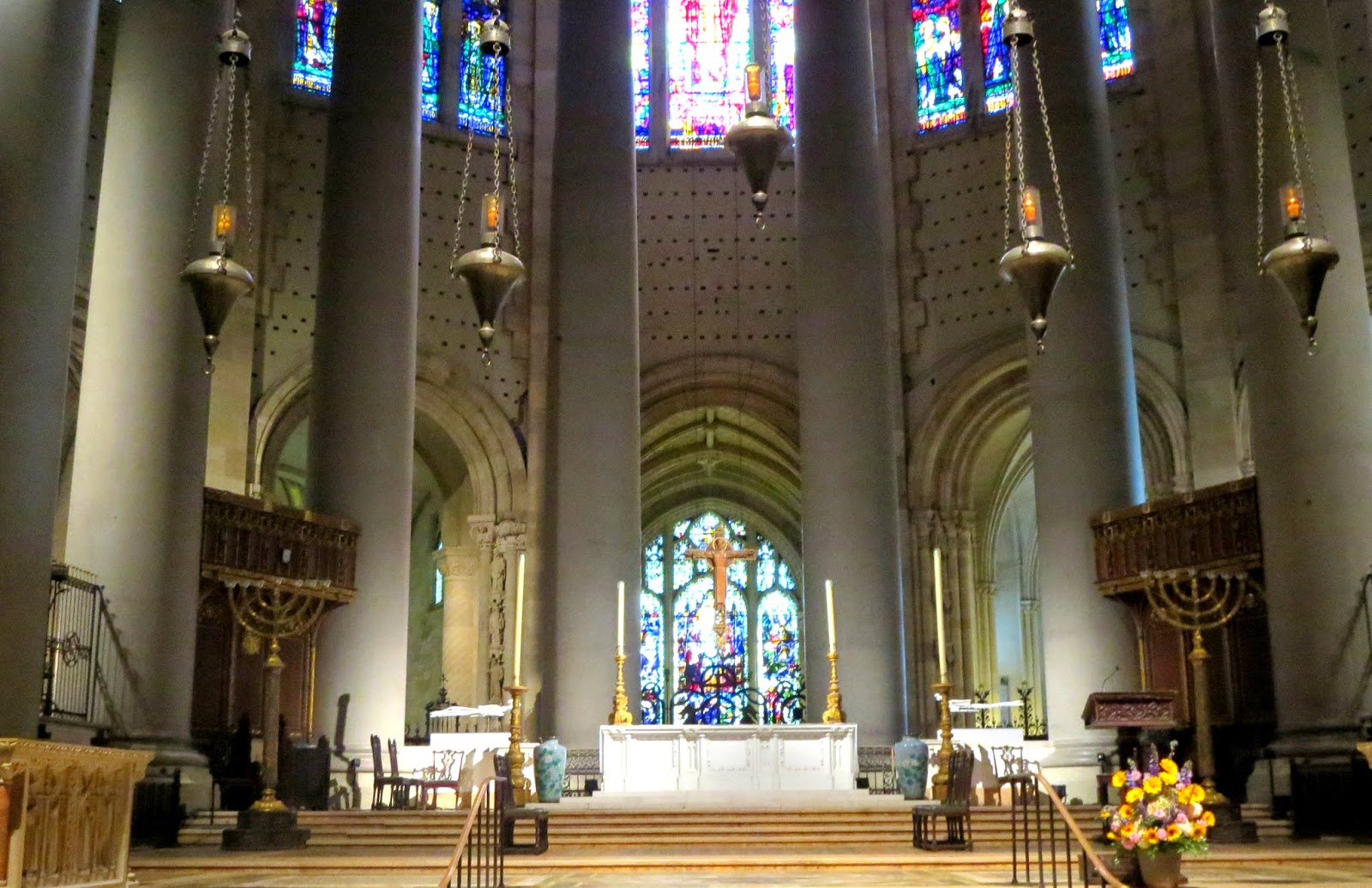
 The Cathedral’s stunning stained glass windows provide the perfect backdrop the  glittering and colorful giant installation.  Thousands of little lights and vibrant colors give soul to the cold, heartless steel, making the birds look absolutely stunning. 
“The Phoenix: Xu Bing at the Cathedral,” installation   opened March 1 and runs through January 2015- so you have time to visit it.
The birds are made of unexpected materials: layered shovels form the feathers,   crowns  are made of weathered hard hats  and birds’ bodies sculpted from  salvaged construction debris.

Born in 1955 in the China, Xu Bing  was exiled to the countryside as part of Mao’s “re-education” during the Cultural Revolution. In 1990  the artist  moved to the U.S. in 1999 he received a MacArthur genius grant. He has since taken up partial residence in China, maintaining studios in both Brooklyn and Beijing.
New York Time wrote: In 2008, Xu was asked to design an art piece for a new building in Beijing’s central business district. When he entered the construction site, he was faced with a camp of migrant workers whose work conditions left a lot to be desired. The phoenixes are the artist’s direct response to what he saw there—the human face of China’s rebirth: Poor people who are building luxury buildings while being treated like scrap metal.

When asked about the birds’ placement, one in front of the other inside the massive Gothic-style church, the artist said  “The girl is closer to God.” Both Feng, the male, and Huang, the female, faced the decoratively carved bronze doors, as if poised to take flight in the middle of the night. “If they faced toward the church,” referring to the altar, Mr. Xu explained, “it would have seemed too religious.” 
Throughout China’s history, every dynasty has had its form of phoenixes.  In ancient and modern Chinese culture, these birds an often can be found  in the decorations for weddings or royalty, along with dragons.   Chinese considered the dragon and phoenix symbolic of blissful relations between husband and wife, another common yin and yang metaphor.  It was believed that the phoenix's song controlled the five tones of Chinese music. The song includes all five notes of the traditional Chinese musical scale.It's flight represents the capacity to leave the world and its problems behind, flying towards the sun in clear pure skies.
The Phoenix: Xu Bing at the Cathedral is the second presentation of these works in the United States. They were previously on view at MassMoCA, North Adams, MA, and have been exhibited in China at the Today Art Museum, Beijing, and Expo10, Shanghai.

The first Jewish community in North America

The beautiful  masonry building in neo-classical style, the present   home of Shearith Israel  congregation  sits in the middle of the Upper West Side historic district.  The New York metropolitan area now  is home to the largest Jewish population in the world outside Israel.  In 2012, more than  1,100,000  Jews lived in New York City (about 12% of the city's population).

 The first Jewish community Shearith Israel was founded in North America in  1654, when New York  had the name  New Amsterdam.   The story behind this community  started  centuries   ago, in 1478, when  King Ferdinand II of Aragon and Queen Isabella I of Castile established the Spanish Inquisition. On April 30, 1492  Spanish King Ferdinand ordered all Jews to leave Spain by the end of July.   Jews gradually migrated throughout Europe , North Africa, Central and South America, including Brazil (under Dutch rule at this time).
When Columbus sailed from Spain on August 3, 1492, there were   several Jews among his 120 men.  Luis de Torres, a Jew from Murcia (south-eastern Spain), served as Columbus’s interpreter . When the ships arrived at Cuba, Luis de Torres decided to remain in Cuba. But  at that   time  he was the only Jew in North America.

In February 1654, a month after Portuguese reconquest,  the Dutch schooner Valck,one of the two remaining  vessels  carrying Brazilian Jewish refugees sailed out of Recife, Brazil. En route it was captured by   pirates . The pirate’s captain forced the ship to land in Jamaica( Spanish colony at that time) , and expropriated  all of the passengers’ possessions.   Some Jews were even incarcerated by the local Inquisition.  
The remaining 23 Jews  who were not jailed   were allowed to depart. 
Flagstaff at Battery Park

When the journey continued, the group stopped   on the western tip of Cuba and then was taken by the French ship St. Catherine to the Dutch colony of New Amsterdam, where they arrived in September, 1654.


This flagstaff, unveiled on May 20, 1955 at Battery Park in Downtown commemorates the 300th anniversary of the arrival of the first Jewish settlers in New Amsterdam and North America.

Stuyvesant, Dutch Director-General of the colony of New Netherland   objected to any settlers who were not members of the Dutch Reformed Church. He  attempted to evict the Jews, but Jewish stockholders in Amsterdam prevailed on the Dutch West India Company to order the narrow-minded governor to let them remain.

Stuyvesant attempted to establish a discriminatory regime ,but the Dutch West India company  instituted a rule allowing Jews to own real estate, trade freely, and be spared discriminatory taxes.
St Thomas Synagogue

Seeing the ominous British power on both sides of the Dutch colony, the Jews gradually left in the 1650s. They went directly to Holland or to other Dutch colonies, including Curacao and St. Thomas .
 The Synagogue in St. Thomas  is the  oldest synagogue in continuous use under the American flag. Famous Jews born here include French Impressionist painter Camille Pissarro and David Levy Yulee, Florida’s first senator.

In the early years in New York  settled near Whitehall Street and later they  moved to Mill Street, which was later called “Jew Street.”  On Mill Street(South William street now) , they built their synagogue in 1728. 

The New York Jewish community continued to grow with new immigrants attracted by the opportunities the port city offered in commerce.

On April 8, 1730, Congregation Shearith Israel, in New York, America’s first synagogue, consecrated its home, the first structure custom-built for a Jewish house of worship in the country. The small building, on Mill Street – what is today South William Street, in the Wall Street area of Lower Manhattan – was dedicated on the seventh day of Passover.


Second cemetery
First Cemetery  of this congregation, dates back to   1683, is  in what is today Chinatown.  The Second Cemetery is hidden behind  the blue wall and  wrought iron fence on West 11th Street.  It caught my attention during a recent walk  in Chelsea. Burials began here in 1805, in what was a much larger, square plot. In 1830 was West 11th Street cut through,   reducing the cemetery to its present tiny triangle. The disturbed plots were moved further uptown to the Third Cemetery  on West 21st Street, and later when in   1852 city law forbade burial within Manhattan, subsequent interments have been made in Queens.
Color photographic postcard of the interior of
Congregation Shearith Israel


The present synagogue building, on 70th Street and Central Park West, is the fifth which The Congregation has occupied.   At the entrance to the synagogue, there are two millstones that were from Mill Street, the location of the town miller during the early colonial period.  They were taken from the site of The first Mill Street synagogue as a reminder of The historic roots in the city. 
There is a replica of The Mill Street synagogue—the Little Synagogue inside the building.  The reader's desk and the four candlesticks surrounding it are also from the Mill Street synagogue.

The Cathedral of St. John the Divine, the largest Gothic cathedral in the world. Part 2

The Bishop of New York has his seat at the magnificent Gothic and Romanesque Cathedral of St. John the Divine, which was erected in the early part of the 20th century at the highest point in Manhattan. You can find the beginning of the story in my previous post.
The Cathedral was opened end-to-end for the first time on November 30, 1941, a week before the bombing of Pearl Harbor.

On the western facade of the building, stonemasons have sculpted numerous scenes that seem oddly out of place for a Cathedral. The most striking one is the chilling depiction of the destruction of New York city and its landmarks.  The scene above was done in 1997, four years before the destruction of the Twin Towers.  Other recognizable skyscrapers are the Chrysler Building and the Citigroup center.


The 15th-century German choir stalls separating the narthex from the nave are on permanent loan from The Metropolitan Museum of Art.

There are Seven chapels,  known as the "Chapels of the Tongues radiate from the ambulatory behind the choir.  Each Chapel  is dedicated to one of the New York nationalities or ethnic groups who worked on the cathedral .
The 3-ton bronze doors below this portal are decorated with relief castings of scenes from the Old Testament on the left and the New Testament on the right. The doors are opened only twice a year: on Easter and in October for the Feast of St. Francis.


At forty feet in diameter, Installed in 1932,  the Rose window High above the doors, is  the third largest rose window in the world and is made of over ten thousand pieces of glass.
According the tradition the Episcopal cathedral is oriented toward the East, facing the sunrise, which fills the southern windows with more bright light than those on the north side . If you take binoculars and look at the northern side stained glass window, installed in 1924 after the Paris Olympics , you can find   guys bowling and auto-racing, playing football, golf, basketball, baseball, and dozens of other sports.

On the pavement of the Choir is the Compass Rose, the official emblem of the Worldwide Anglican Communion. The text surrounding the central cross is in Greek, and translates as: “The truth will set you free.”

The cathedral houses one of the nation's premiere textile conservation laboratories to conserve the cathedral's textiles, including the Barberini tapestries to cartoons by Raphael.
The Cathedral's Poets Corner, created in 1984 to memorialize American writers, is modeled on the Poets’ Corner at Westminster Abbey.      At a dedication service  two giants of 19th-century American literature, Herman Melville and Edgar Allan Poe, had their names inscribed in stone. There are two poets in common: T. S. Eliot, an American who became a British citizen, and W. H. Auden, an Englishman who took American citizenship


There are  stones  dedicated to   Emily Dickinson, F. Scott Fitzgerald, Robert Frost, Langston Hughes, Mark Twain  Walt Whitman, and William Carlos Williams.  Held there were services for Poets Allen Ginsberg and  Joseph Brodsky.   


Brodsky's memorial service surprised some people.  Tchaikovsky's Winter Dreams were  playing at the background, and no words  were spoken about Poet. There were only   poems :    first in English  ( ``Letters From the Ming Dynasty,'' and ``Roman Elegy XII,'’ and after it in Russian: ``The Dominicans,'' ``Lagoon,'' ``The Hawk's Cry in Autumn,'' and, inevitably, ``In Memoriam.''

There's a beautiful 9/11 memorial by  New Yorker sculptor Meredith Bergmann to the right side of the main entrance.
The artist said:" I felt defiantly determined to make as non-Taliban a sculpture as possible: first of all, a nude woman from the tradition of the allegorical female nude, representing New York City as young and strong and alert."


The sculpture is  permanently installed in the Church of St. John the Divine, on a pedestal with glass sides that   holds fragments of the Twin Towers.

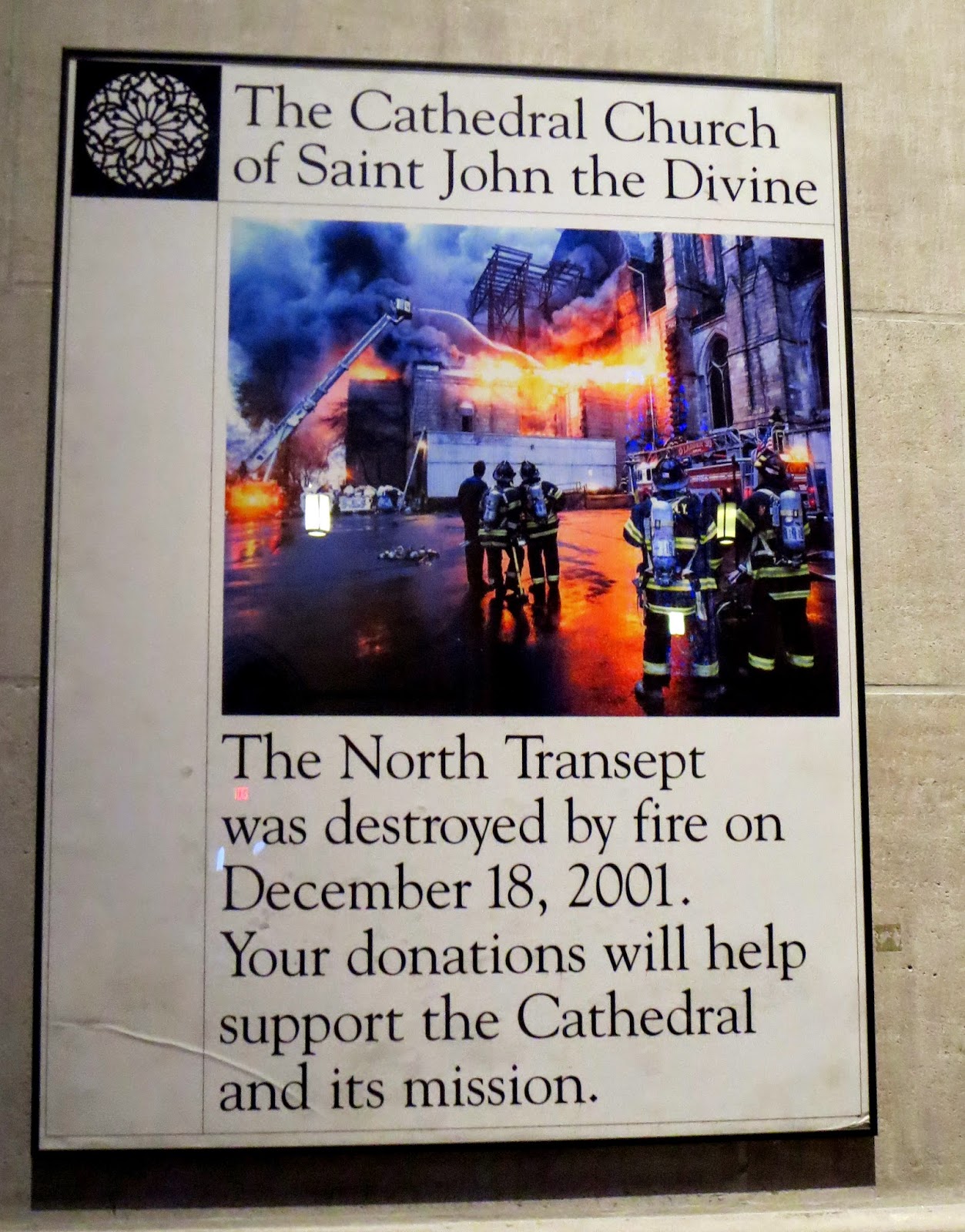
The Cathedral campus boasts six organs.The Great Organ, one of the most powerful organs in the world, was originally installed in 1911 and then enlarged and rebuilt in 1952. The 2001 fire damaged the instrument, but   a  five-year restoration brought it back.   All 8,500 organ pipes were taken out and shipped to Missouri for cleaning.  On Mondays at 1 pm cathedral organists provide a 30-minute break for mind, body and spirit.

The Cathedral is open 7:30 am – 6 pm daily. The Visitor Center and Cathedral Shop are open 9 am – 5 pm daily.

Saint John the Divine is one of the few places left in New York City that allows visitors to access to its roof and a unique vista of the City.  You have to climb more than 124 feet through spiral staircases to get to the top of the church.  Vertical Tour is one hour long and is offered on Wednesday, at 12PM.

Every year in June there is   AnnualSummer Solstice Concert. This year it will be on Saturday, June 21 and will start  at 4:30 in the early morning.  The audience will be seated in concentric circles under the great dome, surrounded by the musicians and instruments, including  nine huge Balinese Gamelan gongs, and other large percussion instruments.

The Cathedral of St. John the Divine, the largest Gothic cathedral in the world. Part 1

The Cathedral Church of St. John the Divine, located  on the upper West Side, is  the largest Gothic cathedral in the world.   Though it's still not finished, it's nevertheless one of New York's most impressive sights.
 A Guide to the Cathedral from 1921 posited that it might take 700 years for the Cathedral to be completed, since it was employing true Gothic building methods - blocks of granite and limestone are carved out by master masons and their apprentices.
The incompleteness of the church reminded me Sagrada Familia, the monumental Barcelona, Spain  church by  Spanish architect Antoni Gaudi.  When  Antoni Gaudi died the church was   less than a quarter complete. Construction began in 1882, and it still continues today.

In New York it is a different story. According to the Church’s website, a frequently asked question is “When will the Cathedral be finished?” The Cathedral’s response — “Although no new construction is planned for the immediate future, efforts have been underway to preserve the Cathedral and its auxiliary buildings for the enjoyment of New Yorkers and visitors from around the world for the centuries to come.”   That’s why St. John the Divine is also known by its popular nickname, Saint John the Unfinished .

The first stone  for the Cathedral  was laid in 1892, and construction continued steadily until 1941, when the attack on Pearl Harbor stalled progress for nearly 40 years. It was a big fire in 2001 and  it took more than seven years for the crew to clean smoke damage.
   

Cathedral stretches the length of two football fields, while the height of the domed crossing can accommodate Lady Liberty (without her platform). Measured by length or internal volume, it is one of the five largest church buildings in the world.   The tall, pointed Byzantine-inspired arches are the most striking feature of the interior, so vast it can comfortably fit 4,500 people  during services.

The first services in the Cathedral were held in the crypt, under the crossing in 1899.The Ardolino brothers from Torre di Nocelli, Italy, did much of the stone carving work on the statues designed by the English sculptor John Angel.  After the large central dome was completed in 1909, the original Byzantine-Romanesque design was changed to a Gothic design.In 1911, the choir and the crossing were opened, and the foundation for Cram's nave began to be excavated in 1916.

 In 1922  the Cathedral installed a stone parapet.  The parapet contained “one sculpture for each of the Christian centuries, each figure being that of the personage who in that 100 years did the most, in the opinion of the Cathedral authorities, for the uplift of the world.”
The twentieth-century niche was left empty with instructions that it was to remain empty for seventy-eight years in order to determine who would be worthy of filling the void for the century. Representing the 17th, 18th and 19th centuries are statues of William Shakespeare, George Washington and Abraham Lincoln

According to the New York Times, the front runners in 1922 were Theodore Roosevelt, Woodrow Wilson, Lloyd George, and Charles Evans Hughes. In 2001 the choir parapet was completed with the addition of a sculpture by Chris Pelletierri of a group of four figures: Martin Luther King, Albert Einstein, Susan B. Anthony and Mohandas Gandhi.