Showing posts with label Lehman. Show all posts

Lehman Brothers. Part 3. The house and art collection at Met Museum.

No.7 on the north side of West 54th Street in the fashionable upscale Upper East Side of Manhattan was built in  1900, on the place where St Luke hospital was. This 4-story limestone house was built for Philip Lehman, who was  the son of  one of the founders of  “Lehman Brothers” corporation and  its first chairman. I wrote about “Lehman brothers” in my old posts ( post 1 and post 2).


Today the Lehman House is one in a row of five surviving turn-of-the-century residences.  Among his neighbors was Moses Allen Starr, a neurologist who had worked with Sigmund Freud ( 5 West 54) and James Junius Goodwin, a banker and a cousin of J. Pierpont Morgan ( double lot 9-11 West 54).  The young John D. Rockefeller Jr. moved into 13 West 54th in 1901. In this house  Nelson Rockefeller died of a heart attack in 1979.

Philip and his wife Cariie had only one son Robert - he inherited the mansion. Robert wrote that his parents went to Europe every year and bought pictures, tapestries and furniture. They bought what they liked and they knew what they want.

Robert succeeded his father as the head of Lehman Brothers and expanded his art collection. Robert was one of the wealthiest people in the United States. For six decades he built upon an art collection begun by his father in 1911.  In 1957 nearly three hundred works were used for a solo exhibit at the Louvre Museum in Paris.

Robert converted his house into private gallery. In 1962 the house was opened to the public for  New York Times called “one of the last great privately held art collections in the world.”  The entrance fee was very high -$25 and was donated   to the Institute of Fine Arts. The price of the movie ticket in 1962 was 50 cents.

After Robert death in 1969 Lehman Foundation donated   Lehman collection    the Metropolitan museum of Art in New York.   Collection includes more than 2,600   paintings,   sculptures, glass, textiles, a enamels, and precious jeweled objects and is one of the  most extensive and exceptional collections in the United States.
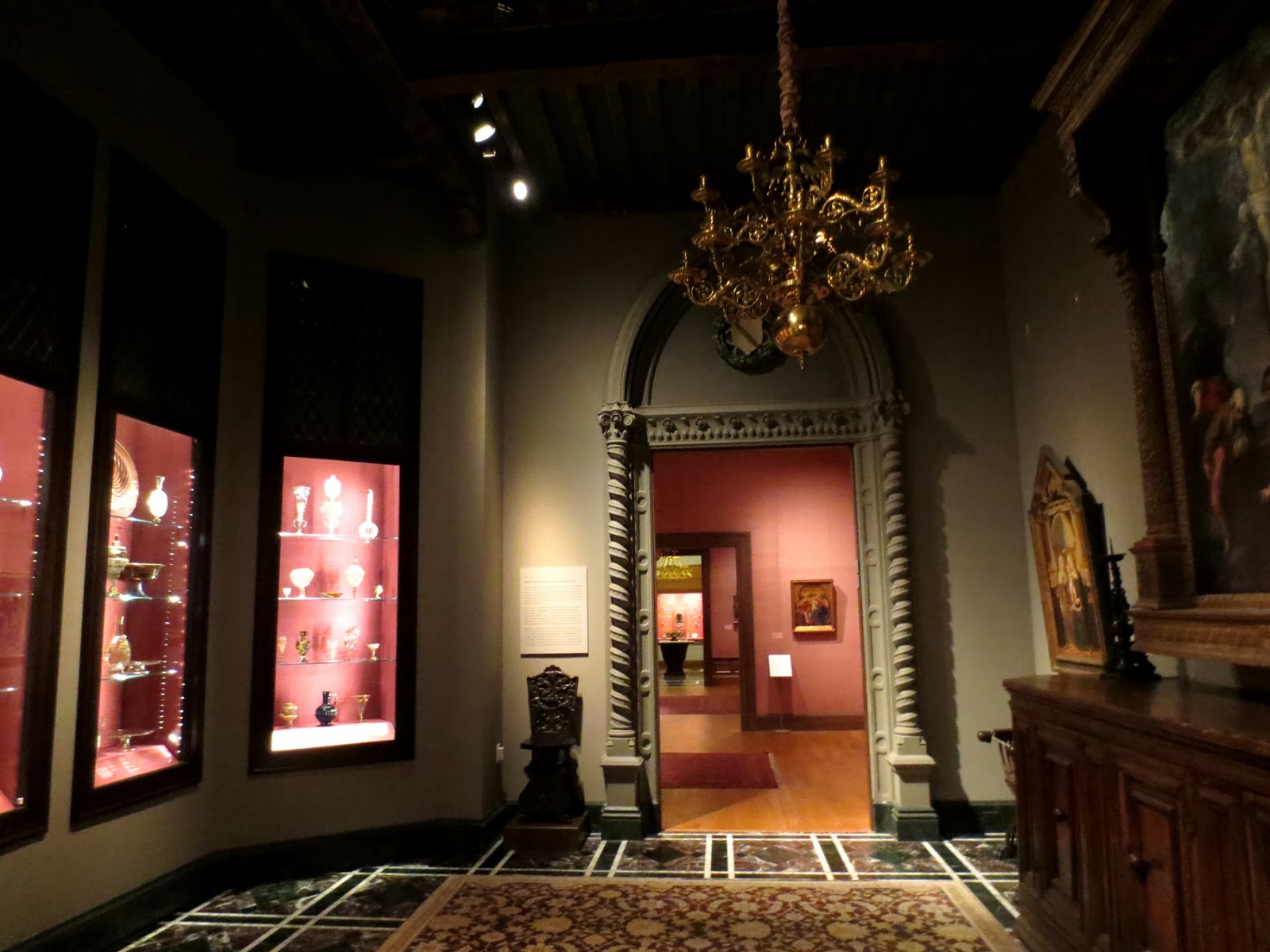
 A new wing was erected in the  museum to display the collection. The Robert Lehman Wing includes a central gallery surrounded by a series of rooms intended to recreate the Lehman family residence. One of the rooms in the   gallery is crowned by a stained-glass dome that originally formed a skylight in the Lehman home.

The Lehman House was purchased by the 7 West 54th Street Realty Corp. in 1974 and went through a series of owners until 2006 when it was purchased by Zimmer Lucas Partners for renovation into offices and entertaining spaces.
The architects restored the limestone façade and built a   modern glass penthouse addition, invisible from the street. The Metropolitan Museum  returned  architectural artifacts which the museum was holding in storage and  allowed the firm to take casts of other architectural details for replication purposes.
 You can fid a virtual tour of the property here.

The house was on sale in 2012 for whopping $65 million.  It is listed now for $49mln  by Corcoran. On June 24  The real  Deal reported   that  the house had a buyer, and it is the most expensive townhouse contract signed so far this year.

Lehman Brothers. Part 2. Big crash.


Five years ago, September 15  Lehman Brothers, the fourth largest investment bank in the world,  filed for bankruptcy, officially kicking off the financial crisis.  It was the largest bankruptcy in history -- larger than General Motors, Washington Mutual, Enron, and Worldcom combined. I wrote about the history of Lehman Brothers corporation in my old post.


Sheraton, Manhattan
In 2000, Lehman celebrated its 150th anniversary . On September 11, 2001, Lehman occupied three floors of One World Trade Center.  One of its employees was killed in the terrorist attacks of that day.  Its global headquarters in Three World Financial Center were severely damaged and rendered unusable by falling debris, displacing over 6,500 employees.
Trading operations moved across the Hudson River to its Jersey City, New Jersey, facilities, where an impromptu trading floor was built in a hotel and brought online less than forty-eight hours after the attacks.
The investment-banking division converted the first-floor lounges, restaurants, and all 665 guestrooms on 51 floors  of the Sheraton Manhattan Hotel  near Times Square (811 7th Avenue, New York, NY)   into office space.   The hotel was built in 1962 as The Americana of New York  to serve the huge number of tourists that the 1964 New York World's Fair would bring.
 
In October 2001, Lehman purchased a 32-story, 1,050,000-square-foot (98,000 m2) office building for a reported sum of $700 million. The building, located at 745 Seventh Avenue, had recently been completed, and not yet occupied, by Morgan Stanley.
 
Five years ago on September 15, 2008 Lehman Brothers filed for Chapter 11 bankruptcy protection. The Dow Jones closed down  4.4% on September 15, 2008, at the time the largest drop by points in a single day since the days following 9-11.  


The Lehman Brothers collapse was the largest bankruptcy filing in U.S. history .  It was the  beginning of the global financial crisis and was a major catalyst of the financial meltdown.  The domino effect began that day.  
 It's not just that exports to the United States shrunken after September 2008; the flow of goods everywhere, in all directions, has fallen.
The fall of the company affected the President election.  There were two distinct phases of the fall presidential campaign in 2008  pre- and post-Lehman. The collapse of Lehman Brothers made it easier for the Obama campaign to frame the election as a referendum on the Bush administration.

 According to Pew Research Center, data analyzing the tone and focus of media coverage through the final stretch of that election showed how that coverage shifted dramatically in mid-September 2008 to focus on the financial crisis and the media narrative grew increasingly critical of Republican candidate John McCain. From Sept. 8-14, 37% of campaign narrative focused on the senator was positive in tone, while 32% was negative (another 31% was neutral).In the period immediately following the Lehman bankruptcy, Sept. 15-23, the tone of his coverage grew much harsher: Only 17% was positive compared with 53% negative and 30% neutral.

Barclays (Former Lehman) building
The former Lehman Brothers   building in Times Square in New York has become the Barclays Capital building for   the British multinational banking and financial services company.  The Lehman slogan  “where vision gets built.”  disappeared from the lighted screens as has the Lehman name. The Lehman deal doubled Barclays' investment banking headcount: Some 10,000 Lehman workers  transitioned to Barclays in early 2009, though a third being were laid off right away.


JP Morgan moved into 25 Bank Street, London,  the former home of Lehman Brothers. The building   was being sold to JP Morgan for $770 million.
Time Life Building
 Five years after its implosion, Lehman Brothers , is still a large corporation with roughly 300 employees working full-time in offices all over the world. Most of its remaining employees work out of two floors of the Time-Life building ( 120 West 51st Street,New York, NY)  not far from the bank's former headquarters in midtown Manhattan. A bankruptcy court opted to liquidate Lehman Brothers.  But that unwinding is expected to take at least several more years.  Lehman has more than $30 billion to recover, and several multi-billion dollar legal fights left over how much creditors will recoup from the remaining assets of Lehman's main U.S. operations


Lehman Brothers. Part 1. The raise of Corporation.

 Five years ago on September 15, 2008 one of the biggest US investment banks crashed and the worst economic crisis in living memory began. The financial calendar can be divided into Before Lehman and After Lehman. 

The history of Lehman Brothers parallels the growth of the United States and its  drive toward prosperity and international prominence.


Hayum Lehman was born to a Jewish family  of cattle merchant in the small town in Bavaria , Germany.  23-year-old Lehman emigrated to the United States in 1844. He settled in Alabama,  changed his name to Henry and  opened  a dry-goods store.   In 1847 his  brother  Emanuel  arrived , and  three  years later   the third one- Mayer   - followed them.    With the arrival of the youngest brother, the firm became "Lehman Brothers".  Cotton was one of the most important crops of America in the middle on XIX century and had a high market value. Brothers started   accepting  raw cotton   as payment for merchandise.
Henry died in 1855, center of cotton trading moved  from the South to the North , and  in 1856 brothers moved the company's headquarters to New York, opening an office at 119 Liberty   Street. The Lehmans were supporters of the Confederacy, and Emanuel acted as an agent in Europe for the sale of Confederate bonds.
Mayer Lehman was one of the organizers of the New York Cotton Exchange, the oldest commodities exchange in New York City.   Emanuel sat on the Board of Governors until 1884.

Philip Lehman, Emmanuel’s son,  became a partner in the family-owned firm in 1887 and  was the first chairman of the board of the Lehman Corporation. In 1900 Philip built a beautiful mansion on the Upper East Side, on the lot opposite the  brownstone at 4 West 54th occupied by John D. Rockefeller. Philip began collecting major artworks in 1911 The collection was  enlarged after his death by his son Robert and now is the largest private collection donated to Metrop[oliten museum of arts. . I’ll tell about the house and collection in one of my next posts.
1 William Street, New York
Philip  was the firm's managing partner from 1901 to 1925.  At that time the  company change the direction  toward the extremely profitable  ventures of underwriting and investment banking. 
For a 20-year period beginning in 1906 Philip Lehman and his friend  Henry Goldman, the   partner in the firm of Goldman, Sachs, formed an alliance to fund the emerging retail industry.  The two firms jointly underwrote securities issues for some of the most famous names in the retailing industry, including Sears, Roebuck & Co.; F.W. Woolworth Co  and R.H. Macy & Co.
Following Philip Lehman's retirement in 1925, his son Robert   Lehman took over as head of the firm. Robert lead  the company until his death in 1969.
The 11-story  steel-framed and limestone-clad skyscraper  in new-renaissance style  on 1 William street , one of the oldest streets in Manhattan , was built  in 1907  for J & W Seligman, an investment bank.
 The Jewish Seligman family from Bavaria emigrated to America ten years earlier that Lehmans. There were eight sons in the family   and all of them were at the beginning in clothing business.  In 1862 brothers   established the firms in New York, San Francisco, London and Frankfort-on-the-Main. The profits and losses of all of them were divided equally among the eight brothers as it was done by the Rothschilds.   In 1879 the Seligmans, with the Rothschilds, took over the whole of the $150,000,000 bonded loan of the United States.
In 1928 it was  acquired by Lehman Brothers.  The corporation occupied  the building  until 1980.  Since its purchase in 1981, the building has been the New York headquarters of the Banca Commerciale Italiana, one of Italy's largest banks, founded in 1862.  In 1996 the building was designated as a landmark by the New York City Landmarks Preservation Commission.
Robert Lehman guided his company through the perils of the stock-market crash of 1929 and the ensuing Great Depression of the 1930s.
In 1975 the firm merged with Kuhn, Loeb and Company to form at the time the 4th largest investment bank.    Since the IPO in 1994 Lehman had steadily increased revenues and grew in employees from 8,500 to approximately 28,000.
In my next post I’ll tell what happened to Lehman Brothers in the XXI century.