Showing posts with label The Metropolitan Museum of Art. Show all posts

Rockefeller and cannibals

The Metropolitan Museum’s Oceanic, or Pacific Islands, collection is one of the finest and most comprehensive in the world.   Nearly 1600 objects from the ''primitive'' cultures of Africa, the Pacific Islands, and the Americas are on view in The Metropolitan Museum of Art's Michael C. Rockefeller Wing.

Before 1982, the Metropolitan Museum of Art, the nation’s premier encyclopedic museum, had no galleries devoted to the cultural achievements of Africa, Oceania, or pre-Columbian art. Early generations of directors of the Met, which opened in its current location on Fifth Avenue in 1880, didn’t think such objects belonged in an art museum.


Kykuit, the Rockefeller Estate. Nelson Rockefellerr lived there.
That was Nelson A. Rockefeller,  who made it his lifetime mission to open the museum to the non-Western cultures whose art he collected and championed.   And he founded  his own museum in 1954  , the Museum of Primitive Art.     Nelson Rockefeller  is the son of D. Rockefeller, Jr. after whom Rockefeller center was named.   He was elected governor of New York in 1959 and was later vice president under Gerald Ford.  As coordinator of the Office of Inter-American Affairs in the early ’40s, he traveled widely in South America.
13-15 West 54

The Museum of Primitive Art opened to the public in 1957 in a townhouse on at 15 West 54th Street, located adjacent to Nelson Rockefeller's boyhood home and directly across from the Museum of Modern Art.  Nelson  donated to the museum his own collection of Tribal art.  Michael, the fifth and last child of Mary Todhunter Rockefeller and Nelson Rockefeller, was 19 when the museum opened.  Michael became one of its board members.


Michael Rockefeller was   born in 1938. He graduated cum laude from Harvard University with a B.A. in history and economics. In 1960, he served for six months as a private in the U.S. Army and then went on an expedition for Harvard's Peabody Museum of Archaeology and Ethnology to study the Dani tribe of western Netherlands New Guinea.  

Asmats  poles in Met Museum
Michael and a friend left the expedition in June for a trip to the southern coast of New Guinea to explore the possibilities of collecting art from the Asmat tribe, one of the last surviving Stone Age cultures.
The Asmats  lived right next to the coast along a main waterway.  They lived without steel, iron, paper or roads, relying solely on wooden canoes to traverse the Arafura Sea.
In October 1961, Michael with anthropologist Rene Wassing visited 13 villages in three weeks, never spending more than three days in one location.  He gathered hundreds of items, among the most prized possession, four sacred bisj poles, spiritual artifacts that are often dedicated to the deceased. The trip was a full success but one trip was not enough.
After a brief stay at home, Michael went back. For nearly two months, he and a friend visited native villages along the coast of New Guinea and up the rivers. On November 18, 1961, in heavy tides and swift currents at the mouth of the Eilanden River, their catamaran overturned.


Two native assistants swam to shore for help. Michael and his friend clung to the canoes for nearly a day. With no help in sight, Michael decided to swim the 12 miles to shore with the help of a life preserver he fashioned from two gas tins tied together with his belt. He was never seen again. His friend stayed with the overturned canoes and was rescued.
A book entitled "Savage Harvest: A Tale of Cannibals, Colonialism and Michael Rockefeller's Tragic Quest for Primative Art" by Carl Hoffman, published in March 2014 gives significant credence to the idea that Michael was killed and eaten by cannibals.
“Headhunting and cannibalism were as right to them as taking communion or kneeling on the carpet facing Mecca,” Michael writes.   But Rockefellers never believed in it.
Twenty years later in 1982, the Rockefeller wing  in Metropolitan museum  opened sponsored by Governor Nelson Rockefeller as a memorial to his son, Michael Rockefeller.   The Museum of Primitive Art closed in 1976, and its collections were transferred to the Metropolitan Museum of Art.


''In opening the installation,'' Philippe de
Montebello, director of the Met, said, ''we are closing the last gap in our encyclopedic coverage of the arts of man, placing works by artists from so-called 'primitive' regions on the level of oriental, classical, medieval and other more recognized arts of the civilized world.''
Some of the most impressive New Guinea pieces include Asmat bis poles that were collected during the Michael Rockefeller expedition of 1961.

America today- the mural from AXA in Met museum

The mural in the Metropolitan museum of Art
In 1919 a  group of American intellectuals  founded the New School.  The professors of Columbia University  stand against   the First World War. They were censured by the Columbia's president,  resigned from Columbia and joined with other progressive educators to create a new model of higher education for adults.  From its inception, the school has held an important place in the intellectual life of New York City and provided employment for numerous European scholars who fled from the Nazis in the 1930s and 1940s.

The New School

 When faced with the need to construct their own facility in 1930, the leaders of the New School desired a building whose architecture would reflect the institution’s progressive philosophy. The first building constructed for the New School for Social Research was designed in 1930 by Joseph Urban, a well-known architect  and theater designer who was trained in  Vienna.

In the same year the New School’s director,  Alvin Johnson,  commissioned  the mural for the school.  The mural was painted by  the artist Thomas Hart Benton.  The artist lived in New York City for twenty years  and  was a  teacher at New York's Art Students League, offering students grounding in European art history, as well as an awareness of European modernism.


 “America Today” was Benton’s first major mural commission.  The ten  panels depict a panoramic sweep of rural and urban life on the eve of the Great Depression.   The mural evokes the  belief in American progress that was characteristic of the 1920s.


Benton said:"It is true my murals include the synthesis of the color and tempo of the jazz age as represented by racketereers, fast women, gunmen, booze houds and so on... My subjects portray American life of the 20th century  realistically".


In  1982 The New School  sold the mural because it was too difficult for the school to maintain it.  Axa equitable bought the mural in 1984 and displayed  it in the company headquarters  at 787 Seventh Avenue.  In 2012 after lobby renovation AXA donated the Mural to the Metropolitan Museum.


 In the exhibition at the Met museum,  the mural is installed in a reconstruction of the New School’s 30-by-22-foot 1931 boardroom, which allows viewers to experience it as Benton conceived it.  There is a black and red color scheme, the same one created for the boardroom by the New School building’s modernist architect, Joseph Urban.


For this, we are tremendously grateful,” stated Thomas P. Campbell, Director and CEO of the Metropolitan Museum. “The Metropolitan’s presentation of Benton’s great mural will shed new light on this visually and intellectually stimulating landmark in American art of the early 1930s, especially as the Museum will display the mural as the artist originally intended it to be seen. Positioning the mural’s new home in the context of the Metropolitan’s diverse collections, the exhibition also tells a unique story rooted in New York’s own cultural history.”


Tthe exhibition will run through April 19, 2015

Metropolitan Museum of Art: unfinished facade and a new plaza

New York City's Metropolitan Museum of Art is one of the largest museums in the world. There are  more than 2 million pieces of art, including  renowned paintings,   porcelain, musical instruments, historical artifacts, costumes and even armaments.  More than 6 million people visited the museum in 2013.  
Museum opened in 1880. Facade and Great Hall, designed by the architect Richard Morris Hunt, opened to the public in December 1902.  Hunt designed the pedestal of the Statue of Liberty and many Fifth Avenue mansions, that were later demolished, and founded both the American Institute of Architects and the Municipal Art Society. Richard Morris Hunt died before construction of the museum  began, and his son carried out the design almost to his specifications.  
 In Hunt’s original design, the four pairs of columns had to be topped by sculpture groups representing  four great periods of art: Egyptian, Greek, Renaissance and Modern.  Between each pair of columns there is a niche where Hunt intended to set a copy of one great work from each historical era.
But these plans were never  realized -  money ran out, the blocks went unfinished, and the niches are still empty.

During last two years the  museum's Beaux-Arts Fifth Avenue facade  was hidden behind  the blue plywood.   Two years ago billionaire industrialist and Metropolitan Museum of Art Trustee David Koch  contributed the entire $65 million cost of the project.
 With an estimated net worth of $41.9 billion, David Koch is the sixth-richest person in the world. In 2008, the David H. Koch Foundation gave $100 million to preserve and renovate the Lincoln Center's State Theater of New York, now known as the David H. Koch Theater. It houses the New York City Ballet.  This gift of  $20,000,000 established the David H. Koch Dinosaur Wing in the American Museum of Natural History.  A cancer survivor, Koch donated  $100 million  to the  Integrative Cancer Research at Koch's alma mater, Massachusetts Institute of Technology in Boston.

The new plaza opened to the public  on  September  10 this year.  David H. Koch said: “The new plaza is something that will not only beautify the Metropolitan Museum, but also Fifth Avenue and the entire neighborhood, by creating a welcoming, warm, and vibrant open space that the public can enjoy. Although the Met is best known for its magnificent art collections, inspiring architecture, and interior grand spaces, the OLIN-designed plaza will also make the exterior of the Met a masterpiece.”

Thomas P. Campbell, Director and CEO of the Museum, said: "Finally, more than a century after the completion of the Met's grand Fifth Avenue facade, and more than forty years after its last plaza renovation, the Museum has created a truly welcoming point of entry, a cityscape that is environmentally friendly and that will please our visitors as they come to experience the unparalleled breadth of masterpieces on display inside. Rather than finding the complexity of the project daunting—from the hauling of granite for new fountains and paving stones, to the planting of trees and the installation of hundreds of LED lights, on an area roughly the equivalent size of three football fields—David Koch recognized its significance, embraced it, and made it happen."

You can find the name of the contributor,  David Koch, on the base of fountains.


An ancient Egyptian temple in New York


If you’d like to see ancient Egyptian temple or obelisk  you do not need to buy expensive tickets and book a hotel in Cairo.  Egyptian artifacts   are spread throughout the world in numerous museums.  More than one obelisk was carried off from its original locale to grace the grounds of a foreign country.  Temples too can be found in the US, and several European countries.  You can go to Metropolitan Museum in New York and see the beautiful sandstone temple  of Dendur standing in the middle of a bright huge hall.


The temple of Dendur is a very early Roman Period temple built during the rule of Augustus who ruled Egypt between 30 BC and 14 AD. Originally, the Temple   stood on a wide, stone built platform on the left bank of the Nile about  50  miles ( 77 kilometers)  south of Aswan. It  was dedicated to  Osiris,   Egyptian god of the underworld and of vegetation  and his wife Isis. 

Aswan dam
Egyptian temples were not simply houses for a cult. The temple in Egypt was  an image of the natural world as the Egyptians knew it. That’s why we can see papyrus and lotus plants at the temple base  and  image of the sun above the gate.   The original reliefs were painted red, blue, green, yellow and black, from archaic descriptions, but those colors were washed away after the first, smaller Aswan dam was built.  In the 19th century, graffiti was left on the temple walls by visitors from Europe.


The Temple of Dendur was one of several monuments of antiquity threatened with permanent submersion by the construction of the Aswan high Dam in Egypt.  

 The Dam was constructed between 1960 and 1970, and has had a significant impact on the economy and culture of Egypt. In June 1956 the Soviets offered Nasser $1.12 billion at 2% interest for the construction of the dam.  The Soviets also provided technicians and heavy machinery. The dam was designed by the Soviet Hydroproject Institute along with some Egyptian engineers.  Work on this massive project was begun in 1960; the Dam was officially opened in 1970.   Nikita Khrushchev called it "the eighth wonder of the world". The High Dam increased the country's irrigated area by a third.  The dam flooded a large area, causing the relocation of over 100,000 people and submerged archaeological sites.

Egypt had requested aid from the world’s nations in saving some its most precious monuments. In 1960  UNESCO made an international call to save this rich historical legacy.  22 monuments and architectural complexes, that were threatened by flooding from Lake Nasser were preserved by moving them to the shores of Lake Nasser.
As a sign of gratitude for the help Egyptian state donated the temple of Debod to Spain , Temple of Taffeh to Germany and  temple of Dendur to US.
The temple of Dendur was removed from its original site   in 1963. The stone blocks of the temple weighed more than 800 tons in total. They were and transported to the United States. Several  institutions made bids for housing the temple, in a competition that was nicknamed the "Dendur Derby" by the press.
There were plans to  re-erect  the temple on the banks of the Potomac River in Washington, D.C ( as Jacquelyn Kennedy proposed)  or on the Charles River   in Boston. But weather conditions  are different in Egypt and US.
The temple's sandstone would have suffered from the outdoor conditions.
Finally, on April 27th, 1967, the temple was awarded to the Metropolitan Museum of Art.  Met asked the city for $1.68 million dollars  to re-erect e temple.  The temple arrived and  was housed in a bubble - the first  air -filled structure ever approved by  the building apartment.


Since September of 1978, the temple has formed the Sackler wing of that museum. There is a reflecting pool in front of the temple and a sloping wall behind it, represent the Nile and the cliffs of the original location. The glass on the ceiling and north wall of the wing is stippled in order to diffuse the light and mimic the lighting in Nubia.


Before  1994  museum visitors   were not permitted closer than 30 feet from the temple entrance and were even forbidden to stand on the stone slab of the temple's forecourt.


The Office of Special Events of The Met Museum  is  available to assist with every detail,  creating memorable events if you'd like to have a party  near  The Temple of Dendur in The Sackler Wing of the museum.

The story of the Three Bears


Central Park sculpture

Once upon a time there was a little girl… I think that you know the story of Goldilocks and the Three Bears from the early childhood.  But do you know that we have “Three bears” sculptures here in New York?  And not only one but three of them less than a mile apart,   done by the same sculptor. The first sculpture is on the kids playground in the Central Park  at Fifth Avenue and 79th Street, and the second one is on the first floor of the Metropolitan museum of art.


Prometheus

These sculptures were done by American artist  Paul Manship, mostly known as the author of the Prometheus  in Rockefeller center.  I wrote about  Prometheus in one of my posts in April 2013.


Although Manship was not an animal sculptor, he had gained his Prix de Rome with a relief of horses, and he loved to include birds and animals in his pieces.


The sculpture at Met Museum
In 1926 sculptor was commissioned to build the Paul J. Rainey Memorial Gateway at the Bronx Zoo in New York.  The double gates were thirty-four feet high  and very expensive  to create. It took almost fifteen years to complete the project.  There are three bears above the left gate done by Manship.  The artist modeled all three animals from careful life study of one of the zoo’s bears. 
When the gates were completed, the sculptor  issued independent casts of this assemblage to recoup some of the gateway’s enormous costs. Manship maintained the poses of the animals but adjusted them from a profile to a frontal composition.
 Bronx Zoo Gates
The sculpture on the gate at the playground

The sculpture from the Metropolitan museum was  cast in Milan and stand outside sculpture’s  house in Lanesville, Massasuchets.  

In 1987   the Graham Gallery bought the sculpture. Later "The group of Bears" was  purchased by the donors  Richard and Sheila Swartz for Met museum.
The  bronze sculpture at the  playground was cast in 1960 and unveiled on October 11. It was a gift  from a Samuel N. Friedman in memory of his wife, Pat.
There is a third sculpture of the three bears, much smaller, on the top of the gates  to another playground.  The gates were created by  Paul Manship.  The Municipal Art Society declared the gates the year’s most distinguished work of art in New York City upon their 1953 installation.

Three bears in Washington


The gates were on another  playground that was closed   in the early 1970s to make way for the museum’s expansion of the Egyptian wing (now the site of the Metropolitan Museum’s Temple of Dendur).  After more than 30 years in storage the gates were restored and installed  in Central Park, at 86 street.   

And there is a forth sculpture of the same bears in  Smithsonian American Art Museum in Washington.


Interwoven Globe in Metropolitan Museum


Interwoven Globe: The Worldwide Textile Trade, 1500-1800,” opened in    September at the Metropolitan Museum of Art. 
The show   runs through January 5, 2014.  The exhibition   is an  amazing overview of more than three centuries of art, commerce, and craft .

Trade textiles   were produced by one culture to be sold to another.  According to a description for the exhibit from the Met’s website, “Beginning in the sixteenth century, the golden age of European exploration in search of spice routes to the east brought about the flowering of an abundant textile trade. Textiles often acted as direct currency for spices, as well as other luxury goods. Textiles and textile designs made their way throughout the globe, from India and Asia to Europe, between India and Asia and Southeast Asia, from Europe to the east, and eventually west to the American colonies.”


The items on display show how trade between different cultures and countries inspired and changed the way cloth was produced and designed, from the techniques and materials used to the designs and colors found decorating the cloth.

The designs on European-made textiles often served as models for Chinese and Indian artists, and the combination of Asian and European motifs resulted in novel designs that were especially popular in the West.


By the end of the seventeenth century, objects imported through the well-established maritime trade routes between Europe, Asia, Africa, and the Americas served as conduits of information about the cultures that produced them. Textiles that moved around the globe stimulated an intense interest in what was deemed "exotic."
Images of fantastic flora, fauna, architecture, and people show how Europeans imagined China, India, and Turkey. The resulting designs and artworks demonstrate a shared curiosity between East and West.  In the eighteenth century, laws protecting the English textile industry prohibited residents of the British Isles from purchasing the Chinese silks and Indian cottons imported by the English East India Company.

These exotic textiles could, however, be legally re-exported to other regions.   Ironically, the English had to dress in domestically produced imitations of Asian textiles, but colonists New York could have the real thing.  After the Louisiana purchase of 1803 the demand for imported Indian chintzes and muslins drastically decreased.
The exhibition is organized by geography and theme in nine galleries. There are quilts and bedcovers, tapestries and wall hangings, shawls and capes, kimonos and vestments, jackets and lavish ball gowns made of imported silks. Most of the textiles are from the Met’s collection but have been exhibited rarely, if at all.
Indian palampore
There are about 130 textiles and nearly 30 garments in the exhibition.   It is a real cross- culture experience and New York is the best place to have this show. You can find exhibition catalogue on Amazon, where you can also enjoy free shipping on it.
Hohloma(Russian Folk art)
What I found amazing is that the type of design that you can see on the eighteen century  Indian bed cover (palampore)   you can find  all over the globe, even on the  hohloma  from Russia and the embroideries from Ukraine.

This type of dyed cloth  was made in abundance in India for the European market in the late seventeenth and eighteenth centuries.
Ukraine folk art picture
 The size of the palampores conformed to bed sizes in Europe, and their decoration, often with a central tree laden with fruits and birds, combined elements from English embroideries, Chinese decorative objects, and Indian textiles.

"NewYorker"  said about this exhibition : "The show is more than a landmark in the study of decorative arts—it’s a model of how museums can deploy their collections in context"

The exhibition catalog for Interwoven Globe  is  a fantastic book for anyone interested in the history of all varieties of textiles. You can buy the  book through Amazon with free shipping.


Lehman Brothers. Part 3. The house and art collection at Met Museum.

No.7 on the north side of West 54th Street in the fashionable upscale Upper East Side of Manhattan was built in  1900, on the place where St Luke hospital was. This 4-story limestone house was built for Philip Lehman, who was  the son of  one of the founders of  “Lehman Brothers” corporation and  its first chairman. I wrote about “Lehman brothers” in my old posts ( post 1 and post 2).


Today the Lehman House is one in a row of five surviving turn-of-the-century residences.  Among his neighbors was Moses Allen Starr, a neurologist who had worked with Sigmund Freud ( 5 West 54) and James Junius Goodwin, a banker and a cousin of J. Pierpont Morgan ( double lot 9-11 West 54).  The young John D. Rockefeller Jr. moved into 13 West 54th in 1901. In this house  Nelson Rockefeller died of a heart attack in 1979.

Philip and his wife Cariie had only one son Robert - he inherited the mansion. Robert wrote that his parents went to Europe every year and bought pictures, tapestries and furniture. They bought what they liked and they knew what they want.

Robert succeeded his father as the head of Lehman Brothers and expanded his art collection. Robert was one of the wealthiest people in the United States. For six decades he built upon an art collection begun by his father in 1911.  In 1957 nearly three hundred works were used for a solo exhibit at the Louvre Museum in Paris.

Robert converted his house into private gallery. In 1962 the house was opened to the public for  New York Times called “one of the last great privately held art collections in the world.”  The entrance fee was very high -$25 and was donated   to the Institute of Fine Arts. The price of the movie ticket in 1962 was 50 cents.

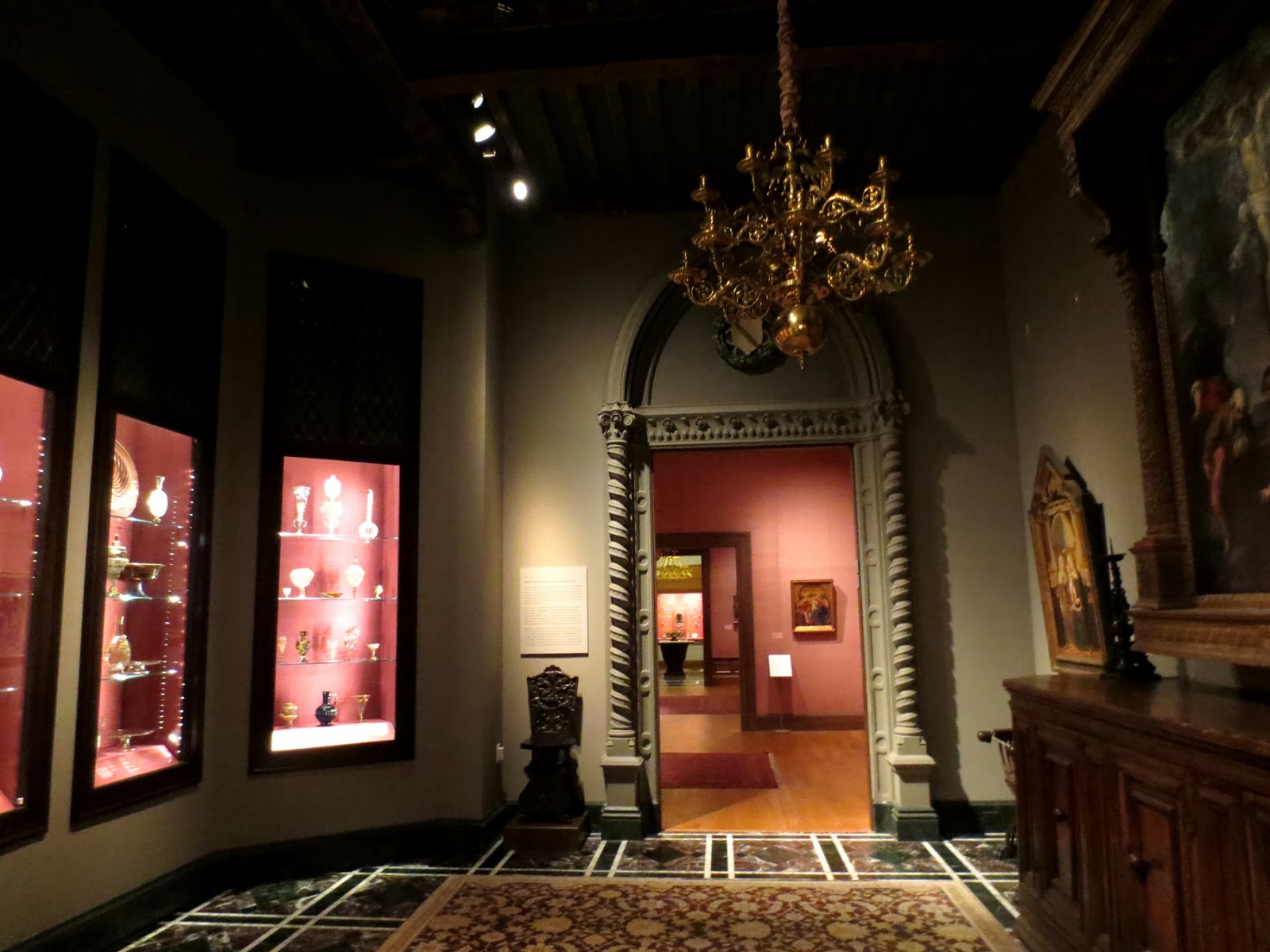
After Robert death in 1969 Lehman Foundation donated   Lehman collection    the Metropolitan museum of Art in New York.   Collection includes more than 2,600   paintings,   sculptures, glass, textiles, a enamels, and precious jeweled objects and is one of the  most extensive and exceptional collections in the United States.

 A new wing was erected in the  museum to display the collection. The Robert Lehman Wing includes a central gallery surrounded by a series of rooms intended to recreate the Lehman family residence. One of the rooms in the   gallery is crowned by a stained-glass dome that originally formed a skylight in the Lehman home.

The Lehman House was purchased by the 7 West 54th Street Realty Corp. in 1974 and went through a series of owners until 2006 when it was purchased by Zimmer Lucas Partners for renovation into offices and entertaining spaces.
The architects restored the limestone façade and built a   modern glass penthouse addition, invisible from the street. The Metropolitan Museum  returned  architectural artifacts which the museum was holding in storage and  allowed the firm to take casts of other architectural details for replication purposes.
 You can fid a virtual tour of the property here.

The house was on sale in 2012 for whopping $65 million.  It is listed now for $49mln  by Corcoran. On June 24  The real  Deal reported   that  the house had a buyer, and it is the most expensive townhouse contract signed so far this year.