Showing posts with label Upper West Side. Show all posts

San Remo - one of the most exclusive coops in Manhattan.


The San Remo (145 and 146 Central Park West)  is a   27-floor, co-operative apartment building in Manhattan located between West 74th Street and West 75th Streets. It is the first twin-towered building to rise in New York.
Past and present residents of the building include Steven Spielberg, Donna Karan, Demi Moore, Dustin Hoffman,  Bruce Willis. Steve Jobs bought and renovated a penthouse apartment but never lived in it. The San Remo sits on the location that was previously occupied by a hotel of the same name.
 
In  1940 the most expensive apartment in the twin towered Art Deco masterpiece was rented for $900 a month by a  stockbroker . Another, with room for a family of five, plus the requisite cook, butler and maid, rented for $540.   In February 2013  one of the apartments   was  listed  for rent  with  the  asking price is $29,750 a month. Nationally, according to U.S. inflation data, since 1940 rents have risen 1,014 percent, so they have gone up about 11-fold. In New York  the increase is of 2,787 percent—close to twice the rate of inflation.

The legendary Emery Roth, of Emery Roth and Sons, was the architect behind the design of the San Remo.  Construction began in 1929, weeks before the market crashed, and took approximately two years to build it.
Emery Roth was born to a Hungarian Jewish  and  emigrated to the United States at the age of 13. During the years between the first and the second World wars  Roth's firm built   some of the most famous coop building in New York  such as  Beresford and Eldorado on  Central Park West and  Ritz Tower  on  Park Avenue. When he died in 1948, he left a remarkable legacy of over 250 apartment buildings in New York City.
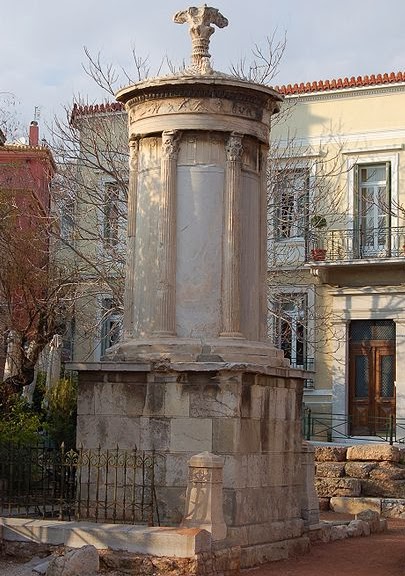
Choragic Monument of Lysicrates
There are two towers of 10 floors each  in San Remo emerging from the lower 17 floors of apartments. Originally designed to conceal water tanks, Roth’s towers eventually evolved into a major element of his designs.
The circular temples at each top  which were inspired by the ancient The Choragic Monument of Lysicrates near the Acropolis of Athens.


The Great Depression left more than a quarter of the units unoccupied.  In 1940,  the San Remo and the Beresford at 211 Central Park West, completed by  Emery Roth in 1929,  were sold for $25,000—total—over their existing mortgages.

The building has been a privately owned co-op since 1972. The board did turn down an application from Madonna in 1985—presumably because of her paparazzi following.  
There are 138 apartments in the San Remo now, although the number fluctuates as apartments are combined or split.   The North tower has one apartment on each floor. With its better views of midtown, the South tower was considered more desirable and was built with duplex apartments. Units are in very high demand and generally cost no less than $2.5 million dollars. As of January 2014  there are two available apartments for sale  - three bedrooms from $6,495,000  and five bedrooms from $7,595,000.
In  2004 election, the San Remo was the single most giving address to Democratic causes. In 2012  New York Times reported  that residents of the building have donated $395,000 to Romney's campaign and just $112,000 to Obama's. A San Remo couple, Kevin and Karen Kennedy, gave $105,000 to the Romney side.
On December 23, 2013, philanthropist Robert Wilson committed suicide by jumping from his 16th floor apartment in the South Tower.

Central Park West   filled with some of the most famous residences in New York City( and San Remo  on the list)    form the Federally designated Central Park West Historic District that runs from 61st to 97th Streets along the western edge of Central Park.


The Secret Society Lodge on Upper West Side


   The nine-story neo-Egyptian structure at 135 West Seventieth Street between Broadway and Columbus Avenue was built in 1928 as a temple for the secret society "The Knights of Pythias". The order was founded by music composer and actor  Justus H. Rathbone, who had been inspired by a play by the Irish poet John Banim about the legend of Damon and Pythias, the legend of the real friendship.


Pythias and his friend Damon were the members of a school, founded by Pythagoras, the father of Greek philosophy and mathematician ( do you remember Pythagoras' Theorem from your school years?)


   A Greek legend told that  when Pythias was sentenced to be executed,  Damon took his place to allow Pythias to get his affairs in order; when Pythias returned in time to save Damon,  the king was so impressed that he let them both live.


The oath taken by members says: “I declare upon honor that I believe in a Supreme Being, that I am not a professional gambler, or unlawfully engaged in the wholesale or retail sale of intoxicating liquors or narcotics…. .Moreover, I declare upon honor that I am not a Communist or Fascist;”

     Early in the order’s history, when a man was inducted into the Knights of Pythias he received a ceremonial sword. Most swords were inscribed with the acronym "FCB," which stands for the Pythian motto ("Friendship, Charity, Benevolence"). 

 There are about 50,000 members of the order worldwide. Among them were ( and are) Presidents McKinley, Harding and Franklin D. Roosevelt , NY Senior Senator Charles Schumer and US Reps. Anthony Weiner, Louis Armstrong and Nelson A. Rockefeller.


     Abraham Lincoln said about the order "The purposes of your organization are most wonderful. If we could but bring its spirit to all our citizenry, what a wonderful thing it would be. It breathes the spirit of Friendship, Charity and Benevolence.”

   The Pythian Temple is one of the masterworks of architect Thomas Lamb, who is known as one of the leading architects of the boom in movie theater construction of the 1910s and 1920s. Lamb built the City Theatre in 1909 for film mogul William Fox. He designed 1914 Mark Strand Theatre, the 1916 Rialto Theatre and the 1917 Rivoli Theatre in New York's Times Square. 

The exterior of Pythias Temple has a heavy mix of Sumerian, Assyrian, and Egyptian motifs, polychrome Doric columns, seated Pharaonic figures, and Babylonian crenellations. There was a 1600-seat auditorium with the Organ on the second floor of the building.


    When originally built, the building was largely without windows, mainly to accommodate the secretive organization. The Knights of Pythias were forced to move from their headquarters in 1958 when they were no longer able to afford rent and maintenance on the facilities. There were rumors that when they departed they left behind a number of relics including staffs, coffins (complete with skeleton), and thrones.
The Grand Lodge Knights of Pythias of New York now is in Long Island, Garden City Park. One of Subordinate Lodges of New York is in Brooklyn , Sheepshead Bay, on 2750 Gerittsen Ave. 
   For less than a year Decca Records occupied the building on West Side, converting the former ballroom into a recording studio. The biggest-selling vinyl rock and roll single of all time - the hit “Rock Around the Clock” - was recorded in this building. Later the building was sold and converted for use as a branch of Manhattan Community College.

The building was sold again in the 1980s, and was converted into luxury condominiums in 1982. Today it is an 88-unit  with no two units alike luxury condo called "The Pythian” . Many of the original terra cotta details are still present, although the exterior now has windows.

Lady Gaga (Stefani Germanotta)   grew up in “ The Pythian”


Ansonia- luxury coop with the farm on the roof and sex club in the basement

     Ansonia is one of the most famous and maybe most unusual apartment buildings in new York. It is located on the intersection of Broadway and Amsterdam Ave, upper West Side. It is more the 100 years old and the history of it is fascinating – there was a farm on the roof, famous gay club and Plato’s Retreat, the sex club, in the basement.
     It was the city’s largest and grandest apartment hotel in New York when it was built. Ansonia was a residential hotel when it was officially opened in April 1904. It had 1400 rooms and more than 300 suits that were connected by pneumatic tubing snaked through the walls. These tubes delivered messages in capsules between the staff and tenants. There was a cooling system - the first one in New York- that kept the building at 70 degrees even on the hotter days.     


     Altogether, with the ballrooms and the dining rooms at full capacity, the hotel could accommodate 1,300 dinner guests. There was the world’s largest indoor pool in the basement. The interior corridors may be the widest in the city.


     There was a farm on the roof with 500 chicken, ducks, a pig, called Nanki-Poo and even a small bear! Every day, a bellhop delivered free fresh eggs to all the tenants. There was a cattle elevator, which enabled dairy cows to be stabled on the roof. In 1907 the Department of Health shut down the farm and animals went to Central Park. Every apartment had lush inventory of towels, napkins, table linen and soap that was refreshed three times a day. Suites were equipped with electric stoves, hot and cold water and freezers and had very thick walls, installed to protect against fire. This feature made the Ansonia apartments one of the most soundproof in the city.


     The doors were so wide that grand pianos could easily be moved in and out. Giulio Gatti-Casazza was a manager of Metropolitan Opera from 1908 to 1935. Before it he was a manager of La Scala in Milan. When he moved to New York with his family he rented apartment in Ansonia. Dozens of opera stars followed them to New York, and almost all rented in the same building. Among the famous renters were Igor Stravinsky, Sergei Rachmaninoff, Gustav Mahler,Enrico Caruso,  Theodore Dreiser.   

     Ansonia was built by William Earl Dodge Stokes, the great son of New York merchant Anson Greene Phelps from an old Massachusetts family. Stokes started his career working in the family business. After the death of his father Stokes contested the will, sued his brother, gained a $1 million inheritance and developed real estate on the Upper West Side. In 1899, Stokes hired architect Paul E. Duboy to build the Ansonia hotel in Manhattan, named after his grandfather.     

     The Ansonia was luxurious, but it was never considered chic and it had a risqué reputation. The hotel first became linked with gambling  just two years after it opened, when Al Adams, the King of the New York numbers racket, moved into the Ansonia straight from a stint in a maximum security prison Sing Sing. He stayed two years in the apartment  before Stokes found him dead of a self-inflicted bullet wound in Suite 1579.      

      Stoke died from pneumonia in 1926. His son Weddie never cared much about the Ansonia and left its operation to a series of management companies, which let the building fall into disrepair. The restaurants and kitchens closed with the Depression. Ansonia turned into a residence with no services. In 1930, the elegant central entrance on Broadway was bricked up and storefronts were installed.    

     In 1942  almost all of glorious metal ornamentation was stripped to supply material for bullets and tanks for World War II. The copper cartouches on the corner domes, each seven feet tall and weighing half a ton, came down. The old cooling systems and copper pneumatic tubes were stripped out of the walls. In 1945, Weddie Stokes sold the Ansonia to a crooked landlord named Samuel Broxmeyer, who milked the building, offering discounts to get tenants to pay several years rent in advance. Broxmeyer eventually got five years in jail, and the Ansonia was sold at bankruptcy auction for a  $40,000 to Jake Starr - one of its mortgage holders.     

     In 1968, Starr rented the abandoned basement swimming pool to a former opera singer Steve Ostrow, who created a luxurious gay bathhouse. The most remarkable thing about the Continental Bath was its cabaret. The line to get in on a Saturday night went down the block.
      In 1977, The Continental Baths was closed  and the new club was opened, Plato’s Retreat.  It was "swingers club" for heterosexual couples.  There was a “membership” fee at the door of $30 per couple—no single men allowed. A sex shop moved into a street-level storefront.
   When New York’s housing codes and laws were changed and residential “hotels” fell under the protection of the Rent Stabilization Board, Jake Starr—then nearly 80 years old—decided: The Ansonia would be better off demolished.

     A weeklong protest and demonstration eventually followed; a petition drew 25,000 signatures, calling for Mayor John V. Lindsay to save the building. On March 15, 1972 the Ansonia Hotel became a landmark. The Ansonia’s final act began with Jesse Krasnow. When he took over, Krasnow’s plan was to fix the violations that Starr had run up and then ask the city to unfreeze the rents. Outraged tenants accused Krasnow of doing only patchwork repairs. The leaky roof became a joke.

    In 1980, the Ansonia Residents Association declared a rent strike. The Ansonia Hotel became the single most litigated residence in the history of New York City. A housing-court judge was assigned full-time to the case, and over the next ten years, Krasnow found himself cast in the role of one of the city’s most villainous landlords. Krasnow realized the best way to make the building functional again was to buy out the tenants who were unhappiest, and in 1990, the tenants accepted a condo plan allowing them either to continue renting or to buy their apartments at a 60 percent discount. Today, 29 percent of the building is rent-protected.

Learn More: