Showing posts with label History. Show all posts

Two Grand Army Plazas- one in Manhattan and another - in Brooklyn

New York City, actually the correct name is “The City of New York”, was formed in 1898 with the merger of 5 counties- New York County, Kings County, Queens County, Bronx County and  Richmond County.  The County names are just used for legal and government purposes, and we all use boroughs names -Manhattan, Brooklyn, Queens, The Bronx, and Staten Island. 


This city started as two world cities facing each other across the Lower East River, the City of New York (Manhattan), with its natural borderland, the Bronx, and the City of Brooklyn  ( the third  largest city in US  at the end of 19 century)  with its borderland, Queens.  Much of the area, especially the Bronx, Queens, and Staten Island, consisted of villages, with farmland in between.
Grand Army Plaza in Manhattan
There are a lot of streets with the same name in different  boroughs : there is a Broadway in all five  boroughs, there is Lexington Avenue in Manhattan and Brooklyn, Madison Avenue in Manhattan and Staten Island, there is   Park Avenue in Manhattan, Brooklyn and Queens, but  mostly these  streets existed long before the merging.  After  boroughs merging nobody renamed the streets.  Because of the duplicate name.
The story about the name  ‘Grand Army Plaza’ is completely different- both plazas were named  AFTER the merging.
Grand Army Plaza in Brooklyn
Grand Army Plaza in Manhattan lies at the Southern-East corner of The Central  Park. The idea for such a plaza was first proposed by sculptor Karl Bitter in 1898.  The plaza was designed  by Carrère & Hastings in 1916 as a New York’s version of the Place de la Concorde in Paris. The New York City Board of Aldermen named it Grand Army Plaza in 1923 after the Grand Army of the Potomac.  The Army of the Potomac was the major Union Army in the Eastern Theater of the American Civil War.

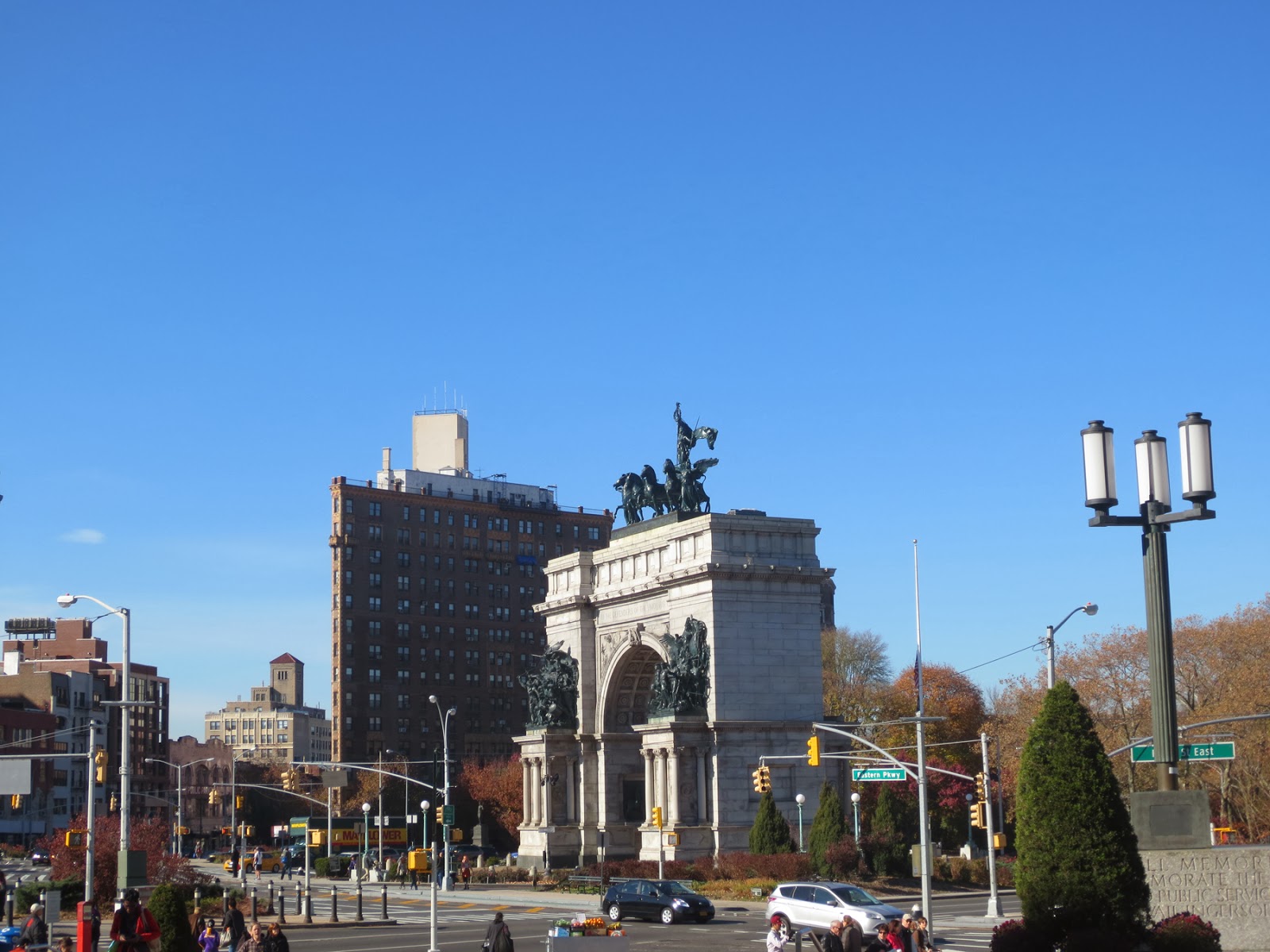
Grand Army Plaza in Brooklyn is to the North of the Prospect Park. Three years after  the naming of  In 1926, the plaza, previously known as Prospect Park Plaza, was renamed Grand Army Plaza to commemorate the sixtieth anniversary of the foundation of the Grand Army of the Republic, a fraternal organization composed of veterans of the Union Army and other military services who served in the American Civil War.
William Sherman
Henry Warner Slocum

So both names are related to American Civil War. Grand Army Plaza in Brooklyn marks the entrance to Prospect Park    and Grand Army Plaza in Manhattan is the gateway to Central Park.  
Both squares have equestrian statues of generals, living at the same time.
This bronze equestrian  statue of General Henry Warner Slocum  in Brooklyn Plaza  (1827–1894) depicts the Civil War hero atop his horse with a raised saber in his right hand. The monument, unveiled on Memorial Day 1905, is located in Brooklyn’s Grand Army Plaza at the top of a small hill at Plaza Street East.
The gilded-bronze equestrian group statue in Manhattan Plaza depicts one of the United States’ best-known generals, William Tecumseh Sherman (1820 – 1891).The monument was installed in 1902.
Both Plazas have the fountains- Fountain of the Golden Spray in Brooklyn Plaza and Pulitzer Fountain in Manhattan Plaza.
So when you say  “Let’s meet at Grand Army Plaza”  please add a location of the Plaza – Brooklyn or Manhattan!


160 years of Steinway. Part 2


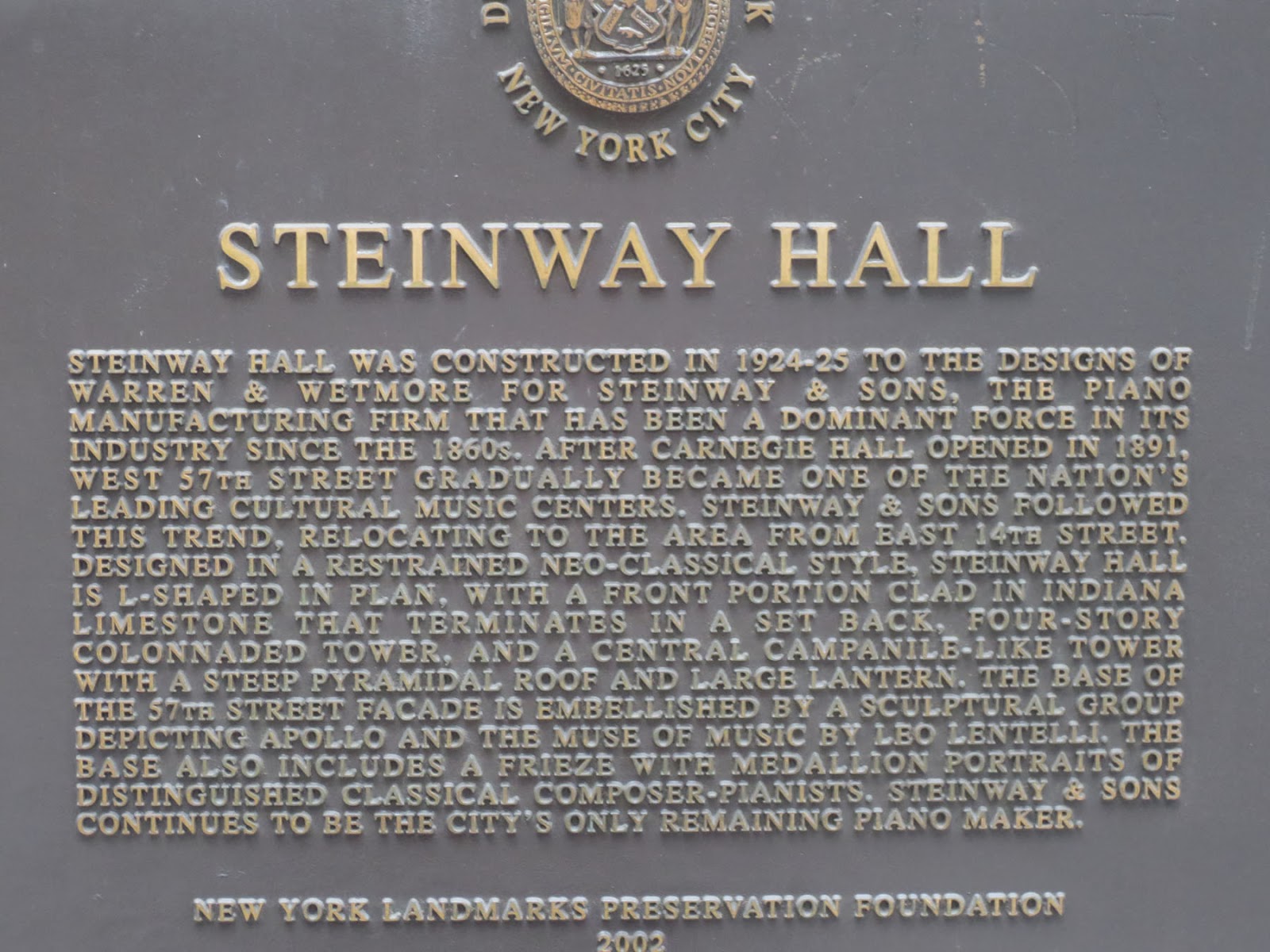
Steinway Hall, West 57 street
Steinway Piano, part 1 can be found here.
 Steinway & Sons company was founded in  1853 by German immigrant Henry Steinway. Steinway Hall, 88-year-old  historic and cultural landmark on 57th Street down the block and across the street from Carnegie Hall, was  sold in August 2013.

In 1866 Steinway & Sons opened the first Steinway Hall ( the building  housing concert halls, showrooms and sales departments )  on 14th Street near union Square.  
The concert hall was designed with 2,000 seats, and had a concert stage for a full 100-piece symphony orchestra. It became New York City's artistic and cultural center, housing the New York Philharmonic until Carnegie Hall opened in 1891. 
 In 1872, Steinway & Sons organized a concert tour of 215 performances in 239 days for the Russian virtuoso pianist Anton Rubinstein.  to promote his piano.  Rubinstein's legendary concert at the Steinway Hall was sold out with 3.000 guests, many of them standing.William Steinway, the son of the company founder,  said: "One concert on Saturday night, sells pianos on Monday morning ".
Theodore Roosevelt piano
In 1902 the 100,000th Steinway Piano was built  for President Theodore Roosevelt.  It was gilded with gold leaf, and American Eagles were  carved on the legs. Today the historic Gold Steinway stands in the First Ladies Hall of the National Museum of American History.
In 1925, Steinway Hall opened to its current location  in a newly constructed   16-story building  on West 57th Street near Carnegie Hall.  The building was built   by Warren and Wetmore - the same company that built Grand Central  in 1913. 
Steinway Hall, West 57 street
 A music themed sculpture of Apollo and the muse of music topped arched entrance. The top of the house  was designed to be part of a penthouse apartment for the president of Steinway, but was turned into a radio studio.  The two-story rotunda is the real centerpiece of Steinway Hall. The main rotunda seats up to 300 guests and a small symphony orchestra.


The mezzanine has  soundproofed rehearsal rooms, named after members of the Steinway family. Each room has a Steinway piano that is equipped with a  connection to personal computers. The only room not named for a Steinway is the Rachmaninoff room, which contains a large portrait of the virtuoso.

The official opening night of the hall was on October 27, 1925 with a performance by Philharmonic Orchestra before 300 invited guests of New York society,  including four Steinway grandson,  Sergei Rachmaninoff,   Andrew Carnegie, Guggenheim and  DuPont.  The entire performance was broadcast over the radio.  
According to legend, it was in the Steinway basement that Vladimir Horowitz and Sergei Rachmaninoff met for the first time. There they played Rachmaninoff’s third Concerto. This piece became Horowitz’s trademark.
The building now bears the name of the current owner, the British publisher, The Economist.  Despite having its “name on the door”, The Economist is nowhere on the premises. Its offices are at 750 Third Avenue.
Below street level is the world famous Steinway Basement with  the Steinway “piano bank” where piano professionals come to select instruments they will use in concerts, in recordings, and on tour. 
In August 2013   Steinway agreed to be acquired by Paulson & Co., the hedge fund owned by billionaire John Paulson for $512 Million. Steinway said that under the terms of the deal, it could remain in the building on 57 street  for up to 18 months.

 Paulson became a billionaire by short-selling subprime mortgages in 2007 and made $3.7 billion that year.  In 2010, he beat a hedge-fund record by making nearly $5 billion. His fortune was made largely from the collapse of mortgage backed securities market. Paulson owns three Steinway pianos  and says he’s planning on buying a fourth. Within a day of the announcement, he sent a letter that said he was not going to change a thing in how Steinway builds pianos.... 

160 years of Steinway. Part 1

Steinway Hall, West 57 st.
Steinway has been in business for 160 years. Its pianos have been a status symbol and a must-have luxury in concert halls for more than a century. Since opening in 1925, Steinway Hall  West 57th Street in the heart of Midtown Manhattan. It is a landmark destination. Such famous names as Franz Liszt, Vladimir Horiwitz,  Sergei Rachmaninoff, Van Cliburn, and George Gershwin chose the Steinway piano as their performance instrument.  
 160 years ago in 1853 the German emigrant Heinrich Engelhard Steinweg ( later he changed his name to  Henry Steinway)  founded a company.  Henry made his first square piano ( a piano that has horizontal strings arranged diagonally across the rectangular case)  in 1835 and presented it as a gift to his  bride. The excellent example of the square piano, made in 1866,  can be found in  Pleshakov Piano Museum, opened in Hunter, Catskill in August of 2007.  
Square piano

Kitchen Piano in Met Museum


In 1836 he built his first grand piano in his kitchen. This piano was later named the "kitchen piano", and is now on display at the New York Metropolitan Museum of Art .  

Over the next thirty years, Henry and his sons developed the modern piano   utilizing acoustical theories of the well known physicist Hermann von Helmholtz.
In 1862 the company gained the first prize in London and   in 1867 at the Universal exposition in Paris.

The company started out with a small shop on Varick Street in Tribeca,New York  but by the 1860s had grown to a huge block wide factory on Park Avenue, and 53rd St. where the Seagram Building stands today. The first piano produced by the company was sold to a New York family for $500. The Steinway factory remained in Manhattan until 1910, when it relocated to Astoria. 
Steinway factory in Queens


Steinway factory in Queens
In 1870, William Steinway ( Henry’s fourth son)  bought 400 acres of land in the northern Astoria section of Queens, New York and established a community for its workers called the Steinway Village,  with its own  foundries, factory, post office, parks and housing for employees.  It was the place where workers could own brick homes, drink fresh water, and stroll under shade trees on Steinway Avenue—still the main road in this part of Queens. 

The Steinway Library, started with books from William’s own collection, is now a branch of the Queens Library.  A public school (one of the first free kindergartens in the country), a fire house, and a post office were also built at that time.  

Steinway Mansion in Queens

During the 1890s, William Steinway began a project to extend his company town's horse-drawn trolley line under the East River  and into midtown Manhattan. 

The tunnels that were dug under the East River were named the Steinway Tunnels after him. Train 7 to Flushing (Queens) uses thus tunnel. 

In 1871, William purchased the Steinway Mansion in Queens. The house was recently put up for sale for $3.5 million in 2011.The house is  the  market now for $2.9.

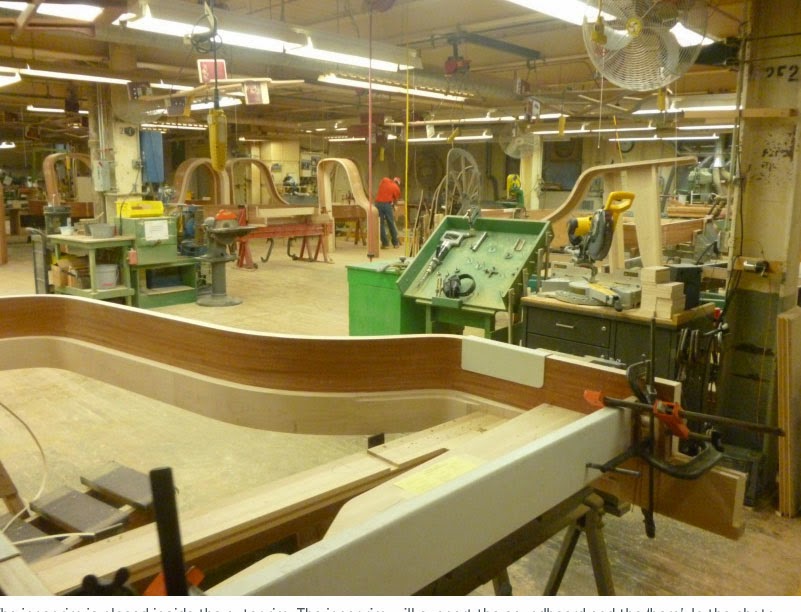
Handcrafting each Steinway piano requires up to one full year. Each piano requires several kinds of lumber, writes Miles Chapin, a great-great grandson of the founder Henry Steinway, in his book “88 Keys: The Making of a Steinway Piano”: birch for the hammers, sugar maple for the rim, and Sitka spruce for the soundboard, among other varieties.  The harp, which weighs three hundred and forty pounds, must sustain the forty thousand pounds of tension necessary to keep the strings in tune.
Steinway factory
You can go on a free factory tour (once a week on a Tuesday,  from September through the end of June)  where the company's famous Steinway pianos are built by hand by skilled artisans.  
 
In 1881, Steinway manufactured more than 2,600 pianos and William  became a millionaire, one of 400 in New York. 
 

But Steinway factory produced not only pianos! 125 years ago on 29 September 1888,  just two years after the first modern automobile had been invented, Steinway entered into agreement with G. Daimler of Mercedes to manufacture parts for the American Mercedes Automobile and the engines as well as marine engines.  The site of the Steinway piano factory in Queens  offered enough space for the production of Daimler engines. Daimler became the first European car manufacturer in the United States of America.
William Steinway had ambitious plans for the motorization of the United States. He  said:  “The cars which we intend to produce for the American market will be capable of carrying between two and four people and will be driven by engines with between 2 ½ and 3 ½ hp. The fuel – petroleum – costs about one cent per hp. and hour, making the automobile considerably less expensive than horse power.”
After Steinway's early death in 1896  his heirs sold all their shares to the General Electric Company.
 

If  you'd like to know what happened next with the company- wait for my next post!


The oldest apothecary in America


C.O. Bigelow Apothecary  at 414 6th Avenue  is the oldest  apothecary in America. It was founded in New York’s Greenwich Village 1838 by Dr. Galen Hunter as the Village Apothecary Shop. Clarence Otis Bigelow worked for Doctor Hunter and eventually took over the shop.
The original store was located a couple doors down from the current address, but in 1902, the ambitious Bigelow built a new building for himself  and the shop.

The  Bigelow archives told that Mark Twain 
( he lived  at 14 West 10th Street in Greenwich Village from 1900 to 1901)  bought the toothpaste there. When Thomas Edison ( as featured in advertisements ) burned his finger on a prototype light bulb, he ran into the store for balm. 

 Eleanor Roosevelt often used her friend Esther Lape's Manhattan apartment at 20 East 11th Street as her "hiding house," a comfortable private space where she could meet friends and colleagues. She often visited the store. Until the in-store soda fountain was torn down in 1984, the lunch counter cooked a whole turkey every day.


Apothecary operates on a slogan: “If you can’t find it anywhere else, try Bigelow.” 

For three generations, Bigelow has been run by the Ginsberg family. Ian Ginsberg, the 50-year-old grandson of the man who bought the store in 1939 now heads up the landmark shop.  Ian  has been working in the store since he was 6 years old.

He travels all over the world looking for unique health and beauty products, and imports many brands hard to find here in the states.
In 1980s  the chain pharmacies started coming Duane Read, CVS, etc. It was difficult time for the company.
 

"We make soaps, perfume oils, essential oils, massage oils, cosmetic bags, and many other items. And we manufacture Alchemy, our own complete line of cosmetics." – said Ian., “We´re a 100-year old pharmacy. You can create a company overnight, but you can´t create 160 years of history overnight." The store-labeled  Bigelow Lemon Body Cream has been a favorite formulation since 1870.


Ian now no longer has any fear of competition from the big chains – he has his own niche:  Bigelow´s specialized in real customer service.
 
The oldest  still-operating pharmacy in the world is  The Santa Maria Novella Pharmacy in Florence, Italy.  It was  established in 1221, when the Dominican monks from the adjacent Basilica of Santa Maria Novella began growing herbs to make balms.  In the 17th century, the pharmacy opened its doors to the public.

In 2012 Officina Profumo-Farmaceutica di Santa Maria Novella will celebrate 400 years of uninterrupted business


Bowling Green park. The tale of two monuments. Part 2

Part 1 of the story is here
Bowling Green, the oldest park in New York, is a small green space just above the Staten Island Ferry and Battery Park.  The park is very small but has a long history.
A gilded lead statue of King George III was erected here in 1770. On July 9, 1776, after the first public reading in New York State of the Declaration of Independence, this monument was toppled the crowd.  The horse and rider were dragged from the pedestal and broken to bits.
Angry citizens planned to impale head of the king upon a stake and kept it aside. But by the next morning the head had been stolen by Tories  (tory-anyone who remained loyal to the British Crown).  A year later the governor of Massachusetts Thomas Hutchinson wrote in his dairy that he saw the head in the home of Lord and Lady Townshend in England.


Fragments of the statue were  shipped to Norwalk in  Connecticut and after that  transported to Litchfield and melted  into bullets for the Revolutionary troops. At Litchfield Gen. Oliver Wolcott built a shed in his orchard and supervised a group of family members and neighbors in casting 42,088 bullets, 20 bullets per pound. This count was recorded in a document that survived. No one noticed at the time that a statue of 4,000 pounds, at 20 bullets to the pound, should have yielded almost twice as many bullets as the 42,088 produced. 

Fifty years later missing pieces began to surface. It is believed that the kitchen step of the mansion of the Cornelius Van Vorst, the twelfth Mayor of Jersey City, was originally the base of the statue. In 1874, Van Vorst donated the stone to the New York Historical Society.
The latest discovery happened in 1970 in the town of Wilton, Connecticut .By the way, In 2007, Wilton was voted as one of CNN Money's "Best Places to Live" in the United States. 

The oxcarts with the pieces of statue stopped for overnight on the fay from Norwalk to Litchfield at the Clapp Raymond Tavern. City resident, using a modern metal detector, discovered a 20 lb. piece in the swamp, but without permission of the property owners. He sold the piece to the New York historical Society  for $5,500. The property owners sued and won after a six-year court fight, and then agreed to go through with the sale to the museum for the same price. You can see other parts of the monument in this museum.

There is no monument in the Bowling Green Park  in our days, but the fence survived. If you look at the large posts of the fence you’ll find that they are uneven and the saw marks still visible today. One of the legend says that there were cast-iron crowns on the posts.


After the war   the nearby Old Dutch Fort was demolished to build a presidential mansion for George Washington. The  first president never occupied the mansion but it  become the official home of New York’s governors. Bowling Green was used as the private garden for the governors.
Washington did not live there but he has still has a strong connection to the area. A wooden statue of Washington  stood for 51  years in the center Bowling Green.
 The statue was removed during 1843 by city authorities. Left in the hands of a private collector for 40 years, it was sold for $300 after his death. The statue was placed atop the temporary  wooden arch , that stood at prior to the current marble structure on the Washington Square in New York. 


By the late 18th century, Bowling Green was the center of New York’s most fashionable residential area, surrounded by rows of Federal-style townhouses. It was neglected in the middle of the 20th century and later restored to its 18th-century appearance. New lampposts and benches were installed. Publisher and philanthropist George Delacorte donated the park’s central fountain.
George T. Delacorte, the founder of the Dell Publishing empire, also donated money to establish the Delacorte Theater,  sculpture of Alice in Wonderland and Musical Clock in Central Park. 

Wi-fi access make it a popular lunch spot. On summer Tuesdays and Thursdays,  a  there is a greenmarket   on Broadway and Battery Park Place from 8 a.m. to 6 p.m.

Bowling Green Park.The tale of two monuments. Part 1


Manhattan's Bowling Green park, sitting at the very beginning of Broadway, is the first official park in New York. At the early days of New York there was cattle market on this place. On March 12, 1733 the city Council authorized the enclose of the small lot in the front of the fort on the southern tip of the island for “the recreation and delight”. 

The world's oldest surviving bowling green in the world is the Southampton Old Bowling Green in England, which was first used in 1299.  

There are many forms of bowling - the Italianbocce, the French petanque and British lawn bowling.

The bowling game was banned for many centuries for most people in England. Henry VII, the  king of England   , played the game, but banned it for the poor because "Bowyers, Fletchers, Stringers and Arrowhead makers" were spending more time at recreational events such as bowls instead of practicing their trade. It was only in 1845 that the ban was lifted, and people were again allowed to play bowls as they wanted.

The  English, Dutch and German settlers all imported their own variations of bowling to America. One  of the earliest mention of it in American literature is by american writer Washington Irving, when Rip Van Winkle awakens to the sound of "crashing ninepins."   

Before 1905  balls were done primary out of  very hard wood. But in 1905, the first rubber ball, was introduced. In. In 1952 automatic production model of pinspotter was  introduce. Today, the sport of bowling is enjoyed by 95 million people in more than 90 countries. Bowling Green in New York is the first permanent American bowling location for lawn bowling. 
Statue of King George III in New York

This park is the site of one of the most symbolic moment of the War ofIndependence. There was an equestrian statue of King George III in the middle of the Bowling Green park erected by the British government in 1770. The monument mirrored the famous Equestrian Statue of Marcus Aurelius in the ancient Roman, erected in 176 AD. The statue in New York   was cast in lead and gilded. The monument was huge with estimated weight about 4,000 pounds.
King George the Third ruled England from 1760 to 1820, the longest reign of any of the male monarchs in England. There are three equestrian statue of King George the Third in Great Britain: in London, Liverpool and Windsor. 

Statue of George III on Snow Hill, Windsor
Equestrian Statue of Marcus Aurelius in Rome

The statue quickly became unpopular and law against vandalism and graffiti was passed in New York in 1773 and an iron fence was built to protect the monument. But it did not help.
George Washington, commander of the Continental forces in New York, read the document aloud in front of City Hall, just a mile to the north from the Bowling green. The wild crowd cheered the inspiring words , then full of revolutionary excitement rushed to the statue of the English king. A number of soldiers, sailors and citizens threw ropes around the statue, pulled it down, and cut it into pieces. Washington later disapprove the act and expressed the hope that “the military would leave this kind of work "to the proper authorities." 
Do you want to know what happened next with the monument?   Wait for my next post to come! 

The famous publisher William Hearst, “The greenest” skyscraper and castle in California. Part 2


Hearst Empire. Part 1

Hearst Corporation is one of the largest diversified media companies in the world. The corporation now includes about 200 separate businesses. Each day, nearly 20,000 people are at work at Hearst.  

     The founder of the corporation is William Randolph Hearst. He built the nation’s largest newspaper chain, his methods deeply influenced American journalism. He was a multi-millionaire  and a son  of a millionaire. A new building for Hearst corporation was built  in 2008 on the top of the old one,build on 1928. It is located near Columbus circle  and Central Park . 


     Hearst mother  left  him the family’s fortune, which included a 168,000-acre ranch in San Simeon, California half way between Los Angeles and  San Francisco.  Hearst spent his child years there and loved the place and built a castle on the lot of more than 15 square miles.

His  original idea was to build a bungalow, according to a draftsman who recounted Hearst's words from the initial meeting: I would like to build something upon the hill at San Simeon. I get tired of going up there and camping in tents. I'm getting a little too old for that.

     Construction started in 1919 and continued through 1947. There are 56 bedrooms, 61 bathrooms and  19 sitting rooms, indoor and outdoor swimming pools, tennis courts, a movie theater, an airfield, and the world's largest private zoo in the castle - so it is not a bungalow at all!

     The castle was designed by architect Julia Morgan - the first female graduate of the prestigious  "Ecole Des Beaux Arts"  in Paris. She was the first woman architect licensed in California. She started on the castle in 1919 and ended only by Hearst's declining health in 1947.   During her 45-year career, she designed more than 700 homes, churches, office buildings, hospitals, stores, and educational buildings. Julia wrote: ”Never turn down a job because you think it’s too small;  you don’t know where it can lead.”

     One of the highlight of the estate is the outdoor Neptune Pool, located near the edge of the hilltop. The Neptune Pool patio has an ancient Roman temple front ( not a copy!) , transported from Europe and reconstructed at the site.  The pool the holds 345,000 gallons of water and includes the oil burning heating system.

A tiled indoor Roman pool is styled after an ancient Roman bath. Hearst was affected by the beauty of the mosaics in the 5th Century Mausoleum in Ravenna, Italy and implemented  similar styles into his pool.


     Eight marble statues, decorating the pool, were carved starting in 1930 by Italian Sculptor  and are the  copies of ancient Greek and Roman statues. Hearst spent millions of dollars expanding the property, building a Baroque-style castle, filling it with European artwork, and surrounding it with exotic animals and plants.

     The Hollywood and political elite often visited the castle. There is a small private  airport   at the bottom of the hill. Guests also could take a private Hearst-owned train car from Los Angeles.  Charlie Chaplin, Cary Grant, the Marx Brothers, Charles Lindbergh, Clark Gable, Franklin Roosevelt and Winston Churchill were among Hearst's guests.

   In 1957, the Hearst Corporation donated the property to the state of California. Hearst Castle became a United States National Historic Landmark on May 11, 1976.  The site attracts about one million visitors per year and you can become one of them.  I was there several years ago. Believe me - it’s amazing!

     When Randolph Hearst left his castle for health reasons, he moved into this Beverly Hills mansion that girlfriend Marion Davies purchased for him in 1946.  The house has 29 bedrooms, three swimming pools, tennis courts, its own cinema and a nightclub. Hearst  spent there the last twenty years of his life. John and Jacqueline Kennedy stayed in this house for their honeymoon.

     The property was briefly listed at $165 million in 2007, and in  2012 price was  $95 million.

     According to the LA Times, the Beverly House’s 4th and current owner, attorney-investor Leonard M. Ross, purchased the mansion over 30 years ago. Unfortunately, it appears Mr. Ross has run into recent financial difficulty and he filed for bankruptcy on May 2013.   Estate is  on the market for  $117.5 million. Anyone interested?

Visit Hearst Castle in California

The Hearst Empire, “The greenest” skyscraper and castle in California. Part 1

Hearst Empire. Part 2

The Hearst Tower, home for the headquarters of the Hearst Corporation, is located at 300 West 57th Street, near Columbus Circle in Midtown Manhattan. It is was the first "green" high rise office building in New York, and the first skyscraper built after  9/11/2001. The founder of the corporation William Randolph Hearst built the nation’s largest newspaper chain. He is considered to be the father of the “yellow” press and had an extraordinary estate sitting on more than 150,000 acres in between Los Angeles and San Francisco with it's own airport and a zoo.  
     The tower on 57 has 46 stories and uncommon triangular framing pattern.  It was built in 2006 on the top of the six-story base completed 78 years  earlier, in 1928. The building was considered the best world sky scrapper of the year 2006  and received the prestigious annual  Emporis Skyscraper Award.
     The old building, designed by architect Joseph Urban, was completed in 1928 and was named “The International Magazine Building”. At that time Hearst owned 12 magazines. From the beginning, the building was structurally reinforced for an office tower.  Plans were filed in 1946, but never executed. The original building has cast stone façade with limestone columns and allegorical figures representing music, art, commerce and industry.  
    Hearst Tower is one of the most environmentally friendly office towers in New York City and is among the top 10% of energy-efficient buildings in the nation. The roof collects rainwater, reducing the amount of water dumped into the City's sewer system during rainfall by a quarter .90% of the Tower's structural steel contains recycled materials. Light sensors inside control the amount of artificial light on each floor, based on the amount of natural light available at any time. The floor of the atrium is paved with heat conductive limestone. The building is naturally ventilated for up to three quarters of the year.
     William Hearst was born in California in 1863. His father was a California Gold Rush multimillionaire. William   was taught in private schools and attended Harvard College.  Later William run his father’s newspaper “San Francisco Examiner”. He upgraded the equipment and hired the most talented writers of this time, including Mark Twain and Jack London. In 1891 his father died, and Hearst inherited   about $15 million dollars ( half of his father’s estate).
     During his college years Williams was inspired by the well-known publisher Joseph Pulitzer and later he bought his newspaper New York Morning Journal  in 1895. This was the beginning of  Hearst Empire.
     William Hearst dominated journalism for nearly a half century. As an editor,  Hearst adopted a sensational brand of reporting later known as "yellow journalism".  Wardman, the editor of   New York Press, was the first to publish the term but he had never defined the term exactly. In 1898 the paper simply elaborated: "We called them Yellow because they are Yellow".

The term was widely popular at the late nineteenth century during the battle between “New York World” by Joseph Pulitzer's and William Randolph Hearst's “New York Journal” .
    The unproved information about the reason of the explosion on the battleship “Maine” and a private letter, published by Hearst,   could be one of the stimulus for a Spanish American War at the end of XIX century.  However, after the war started,   Hearst sailed to Cuba as a war correspondent and provided accurate information about the war.  Four days after the tragedy (more than 250 sailors were killed) , Hearst's New York Morning Journal called for a public collection for a monument to honor the sailors. The monument stands on the Columbus Circle, half a mile from the Hearst Tower. You can read more about the monument in one of my previous  posts.
     In the beginning of the XX century Hearst entered politics.  Hearst did win election to the House of Representatives in 1902 and 1904 and  spent more than  2 million dollars for United States presidential election in  1904.
     By the 1920s, one in every four Americans read a Hearst newspaper. Media empire had grown to include 20 daily and 11 Sunday papers in 13 cities. Hearst  and his empire were at their zenith.
     The Great Depression hit Hearst hard and he was forced   to sell the Washington Times and merge most of his remaining papers late in the decade. Exploring other emerging non-print media, Mr. Hearst began acquiring radio stations in the 1920s. In 1948, he became the owner of one of the first television stations in the country. William Hearst died in 1951 at age 88.
"Citizen Hearst," a documentary about the 125-year-old Hearst Corp. and founder William Randolph Hearst had world premier  at the 2012 Hamptons International Film Festival .
Books about Hearst from Amazon: